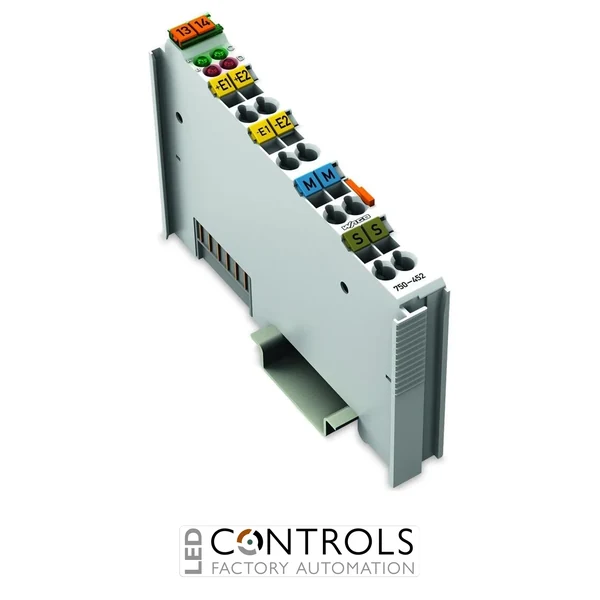
Why Choose the WAGO 750-452 2-Channel Analog Input Module?
The WAGO 750-452 is a high-precision 2-channel analog input module designed for the WAGO I/O System 750. It allows PLCs and industrial automation controllers to measure standard 0–20 mA current signals from sensors, transmitters and process instrumentation.
The module converts analog current signals into digital process data that controllers can use for monitoring, control and automation logic. Each channel uses a differential input design to improve measurement accuracy and noise immunity, making the module suitable for demanding industrial environments. :contentReference
With its compact 12 mm DIN rail housing and reliable CAGE CLAMP® spring terminals, the module integrates easily into distributed I/O systems. It is widely used in process automation, energy systems and manufacturing installations where accurate current signal measurement is required. :contentReference
Key Advantages
- Reliable 2-channel analog input module for industrial automation.
- Supports standard 0–20 mA process signals.
- Differential input design improves noise immunity and measurement accuracy.
- Compact DIN rail module for distributed I/O systems.
- 12-bit resolution for precise signal measurement.
- Integrated electrical isolation between system and field levels.
Key Features
- 2 analog input channels.
- 0–20 mA current signal input.
- Differential input configuration.
- 12-bit measurement resolution.
- Approx. 2 ms conversion time.
- 2-wire sensor connections.
- LED indicators for module status.
- DIN rail mounted modular design.
Industrial Current Signal Measurement
Analog current signals are widely used in industrial automation systems to transmit measurement data from sensors and transmitters. Standard 4–20 mA or 0–20 mA signals are particularly common in process control because they provide strong immunity to electrical noise and allow reliable long-distance signal transmission.
The WAGO 750-452 module converts these signals into digital values that PLCs and controllers can process in real time. This enables precise monitoring and control of variables such as pressure, flow, level and temperature within distributed automation systems. :contentReference
Typical Applications
- Monitoring analog process signals.
- Integration of 0–20 mA sensors and transmitters.
- Process automation and instrumentation systems.
- Energy and utility monitoring.
- Industrial manufacturing control systems.