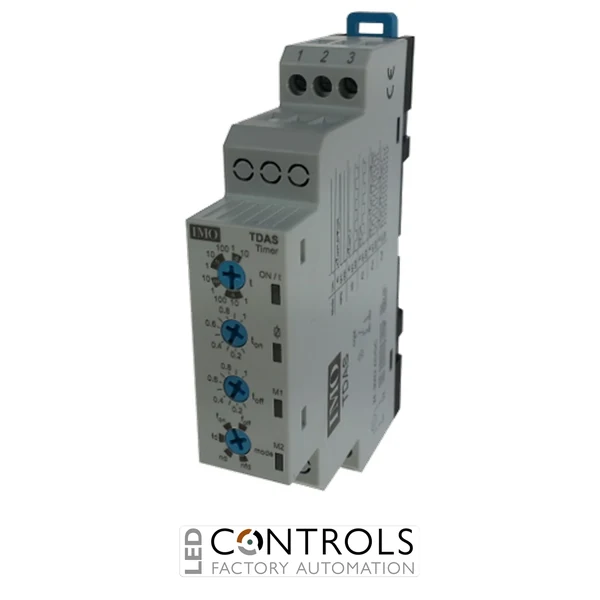
Why Choose the IMO TDAS Analogue Timer Relay?
The IMO TDAS is a compact analogue timer relay designed for accurate time delay control in industrial automation, electrical control panels and machinery applications. It provides dependable timing adjustment for controlling switching sequences, delays and operating cycles in a wide range of industrial systems.
Designed for flexible automation applications, the TDAS combines adjustable timing control with reliable relay switching, making it suitable for machine builders, panel manufacturers and engineers requiring simple and effective timing solutions.
The IMO TDAS timer relay provides a practical solution for applications requiring controlled delays, sequence timing and process automation. Its compact design allows straightforward integration into electrical control systems where reliable timing performance is required.
Key Advantages
- Compact analogue timer relay for industrial automation.
- Adjustable timing control for flexible applications.
- Reliable relay output for switching control circuits.
- Space-saving design for electrical control panels.
- Simple adjustment and straightforward installation.
- Suitable for machinery and industrial automation systems.
Key Features
- IMO TDAS analogue timer series.
- Model: TDAS.
- Adjustable time delay operation.
- Relay output switching.
- Designed for industrial control applications.
- Compact construction for panel installation.
Reliable Timing Control for Industrial Automation
Timer relays provide accurate control of switching sequences, allowing machinery and automation systems to operate with improved precision. The IMO TDAS offers dependable timing control for applications where reliable delays and relay switching are required.
Its compact design and adjustable timing capability make the TDAS suitable for industrial control circuits, machinery applications and automation equipment where simple timing functions are required.
Typical Applications
- Industrial automation systems.
- Machine sequencing control.
- Motor start and stop delay circuits.
- Lighting control applications.
- Pump and process control systems.
- Electrical control panels.