Why Choose the IMO MT5-251-300 Marker?
The IMO MT5-251-300 is a high-quality terminal marker strip designed for clear and reliable identification of electrical terminals, control equipment and industrial wiring systems. Part of the IMO marker identification range, this marker provides a practical labelling solution for electrical panels, automation systems and control cabinets.
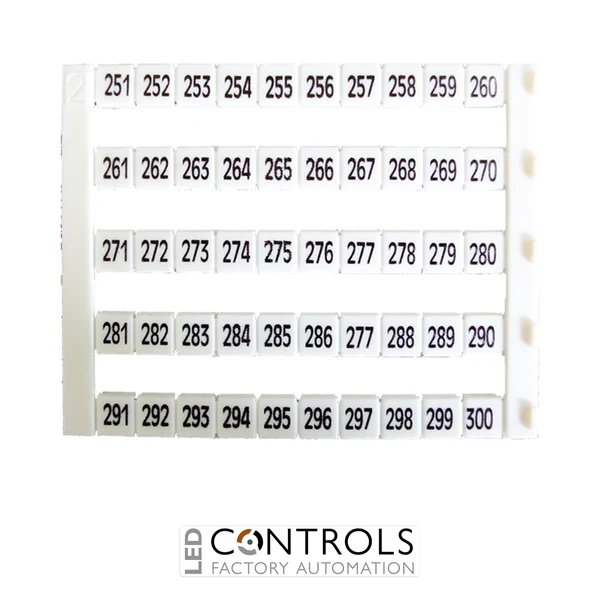
Featuring a white marker surface with printed numbering from 251-300, the MT5-251-300 enables fast and accurate circuit identification while helping improve organisation, maintenance efficiency and fault finding in electrical installations.
With a compact 5 × 5 mm marker format, the IMO MT5-251-300 is suitable for compatible terminal blocks and identification systems where consistent and durable marking is required.
Key Advantages
- Clear terminal identification marker for industrial electrical applications.
- 5 × 5 mm format suitable for compact terminal identification.
- White marking surface provides excellent visibility.
- Printed numbering 251-300 for efficient terminal referencing.
- Improves wiring organisation and maintenance efficiency.
- Suitable for control panels and automation equipment.
Key Features
- IMO marker series.
- Model: MT5-251-300.
- Terminal marker strip.
- Marker size: 5 × 5 mm.
- Colour: White.
- Print range: 251-300.
- Designed for electrical identification applications.
- Suitable for industrial control and automation systems.
Reliable Electrical Identification
Accurate identification is essential for safe and efficient electrical installations. The IMO MT5-251-300 marker provides a simple and effective way to label terminals, helping engineers and maintenance teams quickly identify circuits and reduce installation errors.
Designed for industrial automation and control applications, IMO identification products support professional panel building standards by providing clear and consistent marking solutions for electrical systems.
Typical Applications
- Electrical control panels.
- Industrial automation systems.
- Terminal block identification.
- Machine building and OEM equipment.
- Switchgear and distribution assemblies.
- Electrical maintenance and wiring management.