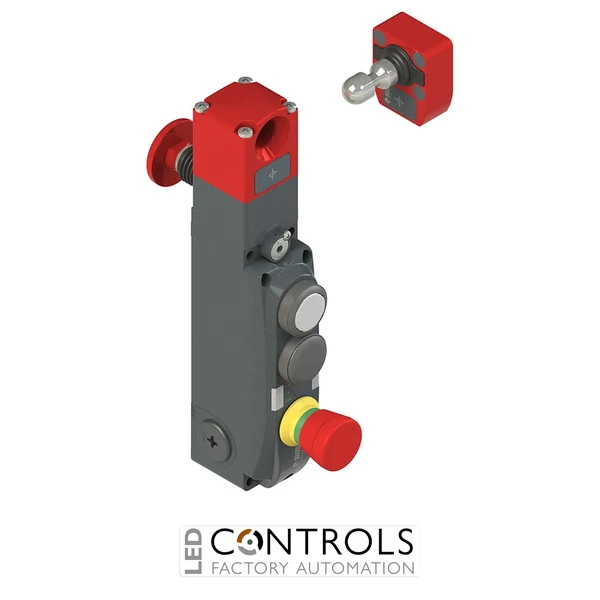
Why Choose the Pizzato NG 2D7D412T-F31 Safety Switch?
The Pizzato NG 2D7D412T-F31 is an advanced RFID safety switch with guard locking and integrated control devices, designed for monitoring and securing movable guards on industrial machinery. Part of the Pizzato NG series, this configuration combines electronically coded guard monitoring, high-strength mechanical locking and local operator-control functionality within a robust industrial assembly.
The switch is supplied complete with the VN NG-F31 high-level coded RFID actuator. This individually coded actuator provides enhanced protection against inappropriate actuator substitution and manipulation, making the switch particularly suitable for machinery where reliable guard identification is an important part of the safety concept.
The NG 2D7D412T-F31 uses the D working method, with the actuator locked while the electromagnet is de-energised. The NG locking mechanism provides a maximum actuator holding force of 9750 N, while the electronic safety architecture provides two safety inputs, two semiconductor safety outputs and separate signalling of actuator-inserted and actuator-locked conditions.
Key Advantages
- Combines RFID guard monitoring, high-strength locking and integrated operator controls within one device.
- Supplied with a VN NG-F31 high-level coded RFID actuator for enhanced protection against manipulation.
- Maximum actuator holding force of 9750 N supports demanding industrial guard-locking applications.
- D working method keeps the actuator locked while the electromagnet is de-energised.
- Two semiconductor safety outputs support direct integration with suitable safety controllers and safety PLCs.
- Dedicated O3 and O4 signalling outputs provide separate actuator-inserted and actuator-locked status information.
- RFID technology provides non-contact electronic actuator detection.
- Integrated control devices reduce the need for separate operator-control enclosures around the guarded access point.
- NG architecture can support high-performance machinery safety systems when correctly integrated.
Key Features
- Pizzato NG series RFID safety locking switch.
- NG 2D7D412T-F31 configuration with integrated control devices.
- Supplied complete with VN NG-F31 high-level coded RFID actuator.
- Non-contact RFID actuator detection with digital coding.
- 9750 N maximum actuator holding force.
- D working method with actuator locked when the electromagnet is de-energised.
- Two safety inputs IS1 and IS2.
- Two semiconductor safety outputs OS1 and OS2.
- Signalling output O3 for actuator-inserted status.
- Signalling output O4 for actuator-locked status.
- I4 or IE1-IE2 inputs for electromagnet activation.
- I3 input for actuator programming / reset.
- Integrated control-device configuration for local machine functions.
- Robust metal NG-series housing.
- Three threaded M20 × 1.5 conduit entries.
- Designed for industrial guard-door and access-gate safety systems.
Integrated Guard Locking and Operator Control
The Pizzato NG 2D7D412T-F31 combines electronic guard monitoring, mechanical guard locking and integrated operator-control functionality at a single machine access point. RFID technology electronically identifies the supplied high-level coded actuator, while the mechanical locking system physically retains the actuator whenever access to the hazardous area must remain prevented.
The switch provides IS1 and IS2 safety inputs together with OS1 and OS2 semiconductor safety outputs for integration into an appropriate safety-control architecture. Separate O3 and O4 signalling outputs allow the control system to distinguish between the actuator being inserted and the guard locking mechanism being engaged, providing useful diagnostic information for automated machinery.
Typical Applications
- Industrial machine guard doors and access gates.
- Robotic cells and automated manufacturing systems.
- Packaging and processing machinery.
- Automated assembly and production lines.
- Conveyor and material-handling systems.
- Machine tools with hazardous or high-inertia movement.
- Guarded access points requiring integrated local operator controls.
- Machinery requiring separate monitoring of guard position and locking status.
- OEM machinery and integrated industrial safety systems.