Why Choose the Pizzato NG 2D7E321C-F30 Safety Switch?
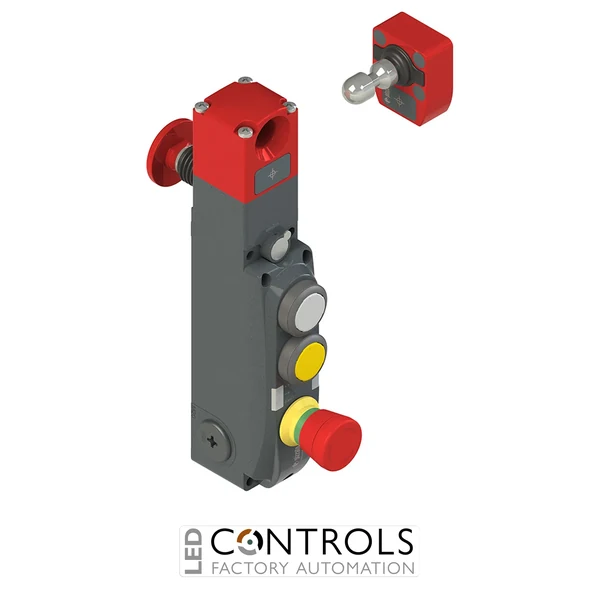
The Pizzato NG 2D7E321C-F30 is an advanced RFID safety switch with guard locking and integrated control devices designed for secure monitoring and controlled access to movable guards, doors and protective barriers on industrial machinery. Part of the Pizzato NG series, it combines coded non-contact actuator detection, electronic safety monitoring, guard locking and three integrated operator devices within a single industrial safety assembly.
This model uses the E working method, meaning the actuator is locked when the electromagnet is energised. Its electronic safety architecture provides two safety inputs and two electronic safety outputs, together with dedicated signalling outputs for actuator insertion and actuator locking. This enables the switch to communicate essential guard status information to compatible safety controllers and machine automation systems.
The NG 2D7E321C-F30 is supplied with the VN NG-F30 low-coding-level RFID actuator. The integrated three-device cover configuration includes a white pushbutton with 1NO + 1NC contacts, a yellow pushbutton with 1NO + 1NC contacts and a red emergency pushbutton with rotary release. The rotating head also incorporates an escape pushbutton, while the metal housing provides three M20 × 1.5 threaded cable entries.
Key Advantages
- Combines RFID guard monitoring, guard locking and three integrated control devices within one industrial safety assembly.
- VN NG-F30 coded RFID actuator is supplied for a matched switch-and-actuator installation.
- E working method locks the actuator when the electromagnet is energised.
- 9750 N actuator holding force supports demanding industrial guard-locking applications.
- Non-contact RFID detection provides electronic monitoring of the associated machine guard.
- Two safety inputs and two electronic safety outputs support integration with compatible safety controllers.
- Dedicated signalling outputs provide information about actuator insertion and locking status.
- Three integrated control devices provide convenient local machine operation at the guarded access point.
- Emergency pushbutton with rotary release provides an additional local emergency-control function.
Key Features
- Pizzato NG series RFID safety locking switch.
- RFID coded non-contact actuator detection.
- VN NG-F30 low-coding-level actuator supplied.
- E working method with actuator locked by energised electromagnet.
- 9750 N actuator holding force.
- 2 safety inputs IS1-IS2.
- 2 electronic safety outputs OS1-OS2.
- O3 signalling output for actuator inserted status.
- O4 signalling output for actuator locked status.
- I4 or IE1-IE2 inputs for electromagnet activation.
- I3 input for reset.
- Mode 2 safety output activation with safety outputs active when the actuator is inserted.
- Three-device cover configuration.
- Position 1: white pushbutton, 1NO + 1NC.
- Position 2: yellow pushbutton, 1NO + 1NC.
- Position 3: red emergency pushbutton with rotary release, 2NC.
- Rotating head with escape pushbutton.
- Metal housing with three M20 × 1.5 threaded cable entries.
- Supplied without connector.
Reliable Safety Control for Industrial Machinery
RFID safety locking switches such as the Pizzato NG series are designed for machinery where protective guards must be monitored and secured while hazardous conditions are present. RFID actuator recognition provides coded electronic guard detection without mechanical contact, while the integrated locking mechanism helps prevent the associated guard from being opened until the machine safety system permits release.
The NG 2D7E321C-F30 combines electronic guard monitoring and locking with three integrated control devices, providing machine operators with local control functions directly at the guarded access point. Its E working method locks the actuator when the electromagnet is energised, while the two safety outputs and dedicated signalling outputs allow compatible control systems to monitor actuator insertion and locking status.
Typical Applications
- Industrial machine guards and access doors.
- Robotic cells and automated manufacturing systems.
- Packaging and processing machinery.
- Machine tools and machining centres.
- Assembly and production lines.
- Conveyor and material handling equipment.
- Protective gates around hazardous machinery.
- OEM equipment requiring integrated guard locking and operator controls.
- Machinery requiring local emergency and operator controls at protected access points.