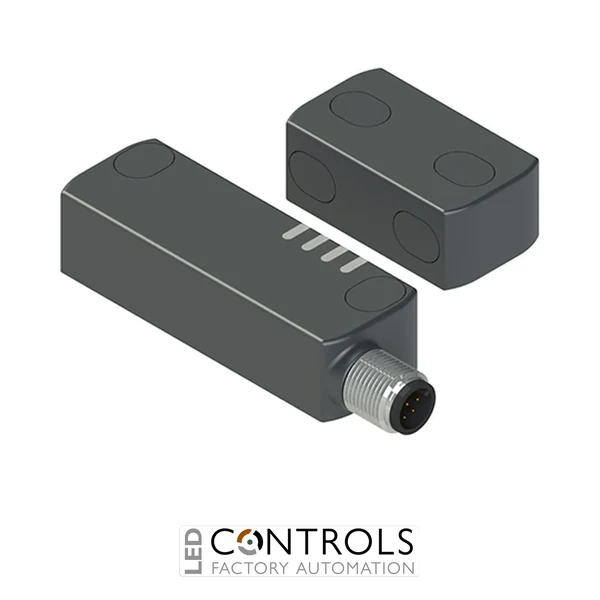
Why Choose the Pizzato ST DD611MK-D1T Safety Sensor?
The Pizzato ST DD611MK-D1T is an RFID non-contact safety sensor with high-coded actuator designed for monitoring guards, doors, covers and other movable protective devices on industrial machinery. Part of the Pizzato ST D series, it combines digitally coded RFID actuator recognition with redundant electronic safety technology to provide dependable guard-position monitoring without mechanical contact between the sensor and actuator.
The ST DD611MK-D1T provides 2 safety inputs IS1-IS2, 2 safety outputs OS1-OS2 and a signalling output, supporting flexible integration into modern machine safety architectures. ST D sensors are designed for high-integrity safety applications and can achieve up to SIL 3, PL e and Category 4 when correctly integrated into a suitable safety system.
This configuration features an integrated M12 connector positioned on the right-hand side and uses a D1T high-coded RFID actuator. The D-format actuator provides an actuation distance of approximately 12 mm, while the robust technopolymer construction and IP67 / IP69K protection make the sensor well suited to demanding industrial automation environments.
Key Advantages
- Non-contact RFID safety sensing technology eliminates mechanical actuator wear.
- D1T high-coded actuator provides enhanced protection against inappropriate actuator substitution and guard manipulation.
- 2 safety inputs and 2 safety outputs support flexible machine safety integration.
- Dedicated signalling functionality provides additional sensor and guard status information.
- Approximately 12 mm actuation distance provides practical tolerance for machine guard alignment.
- Integrated M12 connector simplifies installation, replacement and servicing.
- Redundant electronic architecture supports applications up to PL e, Category 4 and SIL 3 when correctly integrated.
- Up to 32 sensors can be connected in series while maintaining PL e in a correctly designed safety system.
- IP67 / IP69K protection supports operation in harsh industrial environments.
Key Features
- Pizzato ST D series RFID safety sensor.
- RFID coded non-contact switching technology.
- 2 safety inputs IS1 and IS2.
- 2 electronic safety outputs OS1 and OS2.
- D1T high-coded RFID actuator.
- Approximately 12 mm actuation distance.
- D-format actuator designed for non-contact guard detection.
- Integrated M12 connector.
- Electrical connection positioned on the right-hand side.
- 4 LEDs provide clear sensor status indication.
- Robust technopolymer housing.
- No mechanical sensing elements for reduced wear in high-cycle applications.
- IP67 according to EN 60529 and IP69K according to ISO 20653.
- Designed for safety applications up to SIL 3 and PL e, Category 4.
Reliable Non-Contact Guard Monitoring for Industrial Automation
RFID safety sensors such as the Pizzato ST DD611MK-D1T monitor movable machine guards without requiring physical contact between the sensor and actuator. When the associated high-coded D1T actuator enters the sensor's operating zone, the electronic safety outputs communicate the guard condition to the safety controller or safety circuit, helping machinery operate only when the required safety conditions are satisfied.
The high-coded RFID actuator provides increased protection against manipulation, while the ST D series' redundant electronics allow high-integrity machine safety systems to be developed with a single sensor on each guard. Compatible ST D sensors can also be connected in series, with up to 32 sensors supported while maintaining PL e when the complete system is correctly designed, providing an efficient solution for machinery with multiple monitored access points.
Typical Applications
- Machine guard and access door monitoring.
- Industrial automation and robotic cells.
- Packaging and processing machinery.
- Conveyor and material handling systems.
- Machine tools and automated manufacturing equipment.
- Production lines with multiple series-connected guard sensors.
- Frequently operated safety guards and protective covers.
- OEM machinery requiring high-coded RFID guard detection.