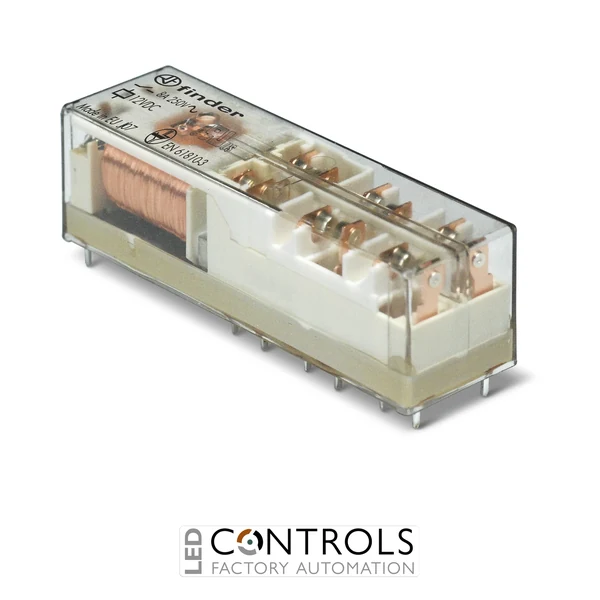
Why Choose the Finder 50.16.9.012.5420 Safety Relay?
The Finder 50.16.9.012.5420 is a six-pole electromechanical safety relay from the Finder 50 Series, specifically designed for applications requiring forcibly guided contacts. Featuring a 12 V DC operating coil, four normally open (4 NO) contacts and two normally closed (2 NC) contacts, this relay provides reliable switching and contact-state monitoring for safety-related electrical control systems.
Manufactured with Type A forcibly guided contacts in accordance with EN 61810-3, the Finder 50.16.9.012.5420 provides a mechanically linked contact arrangement that helps support fault detection in appropriately designed safety circuits. Its 8 A rated contact current, 250 V AC rated contact voltage and silver tin oxide contacts with gold plating (AgSnO₂ + Au) make it suitable for a range of industrial control and safety-monitoring applications.
The relay features PCB through-hole mounting, a 5 mm terminal pitch and a compact housing measuring approximately 55 × 16.5 × 16.5 mm. Its RT III wash-tight protection category, reinforced coil-to-contact insulation and six independent contact circuits make it particularly suitable for safety relay assemblies, machinery control electronics and industrial automation equipment.
Key Advantages
- Type A forcibly guided contacts designed for safety-related control applications.
- EN 61810-3 contact guidance supports contact-state monitoring and fault detection.
- Six contact circuits provide flexible control and monitoring functionality.
- 4 NO + 2 NC configuration enables multiple switching and feedback functions.
- 12 V DC operating coil for compatible low-voltage control electronics.
- 8 A rated contact current for appropriately rated electrical loads.
- 15 A maximum peak contact current under specified conditions.
- Silver tin oxide contacts with gold plating support dependable switching performance.
- 0.8 W nominal coil consumption supports efficient DC control operation.
- Reinforced coil-to-contact insulation provides electrical separation.
- 6 kV impulse withstand voltage between coil and contacts.
- RT III wash-tight construction supports suitable PCB assembly and cleaning processes.
- PCB through-hole mounting allows integration into industrial electronic assemblies.
- Compact six-pole design reduces the need for multiple separate relays.
Key Features
- Finder 50 Series safety relay.
- 50.16 six-pole electromechanical relay design.
- Type A forcibly guided contacts.
- Contact guidance compliant with EN 61810-3.
- Four normally open contacts (4 NO).
- Two normally closed contacts (2 NC).
- Six mechanically linked contact circuits.
- 8 A rated contact current.
- 15 A maximum peak contact current.
- 250 V AC rated contact voltage.
- 400 V AC maximum switching voltage.
- 2,000 VA rated AC-1 switching capacity.
- 12 V DC nominal coil voltage.
- 180 Ω nominal coil resistance.
- Approximately 66.7 mA nominal coil current.
- 0.8 W nominal coil consumption.
- Silver tin oxide contacts with gold plating.
- Reinforced coil-to-contact insulation.
- 8 mm coil-to-contact clearance and creepage.
- 6 kV coil-to-contact impulse withstand voltage.
- RT III wash-tight protection category.
- PCB through-hole mounting.
- 5 mm terminal pitch.
- −40 to +70 °C operating temperature range.
The defining feature of the Finder 50.16.9.012.5420 is its Type A forcibly guided contact arrangement. Unlike conventional relays, the normally open and normally closed contacts are mechanically linked so that they cannot simultaneously occupy incompatible closed states under the fault conditions addressed by the relevant standard.
This construction allows suitably designed monitoring circuits to detect certain contact faults, including a welded contact. The relay's four normally open contacts can be used for switching functions, while the two normally closed contacts can provide feedback to the associated monitoring electronics.
All six contacts belong to the forcibly guided arrangement, making the relay useful in applications where contact-state monitoring is an important part of the safety architecture.
Important: A forcibly guided relay is a component used within a safety system; it does not independently provide a complete safety function or establish a particular Performance Level (PL) or Safety Integrity Level (SIL). The complete circuit must be designed, evaluated and validated for the intended safety requirements.
The Finder 50.16.9.012.5420 operates using a 12 V DC electromagnetic coil. When energised, its four normally open contacts close and its two normally closed contacts open. When the coil is de-energised, the contacts return to their normal positions, provided the relay is operating correctly.
The coil has a nominal resistance of 180 Ω, corresponding to approximately 66.7 mA nominal current and 0.8 W power consumption. This allows the relay to be driven by an appropriately rated DC control circuit.
The AgSnO₂ + Au contact system combines silver tin oxide switching characteristics with gold plating. The relay also provides reinforced insulation between the coil and contact circuits, including a 6 kV impulse withstand rating.
Compact PCB Mounting and Wash-Tight Construction
The Finder 50.16.9.012.5420 is designed for direct PCB through-hole mounting, with a 5 mm terminal pitch and an approximate body size of 55 × 16.5 × 16.5 mm. This configuration allows six contact circuits to be incorporated into a compact electronic assembly.
Its RT III wash-tight construction provides protection suitable for specified PCB washing processes. The relay is particularly useful for manufacturers developing safety interface boards, industrial monitoring equipment and machinery control electronics.
PCB track sizing, contact loading, coil drive capability, electrical clearances and applicable safety requirements should be verified as part of the final equipment design.
Typical Applications
- Safety relay modules and monitoring assemblies.
- Emergency-stop monitoring circuits within validated safety systems.
- Industrial machinery safety control electronics.
- Guard-door and safety interlock monitoring systems.
- Safety-related PLC interface equipment.
- Industrial automation and control boards.
- Contact-state feedback and fault detection circuits.
- Manufacturing equipment safety interfaces.
- Industrial control and signalling systems.
- OEM safety-related electronic assemblies.
- Electrical control equipment requiring forcibly guided contacts.
- PCB-based multi-contact switching applications.