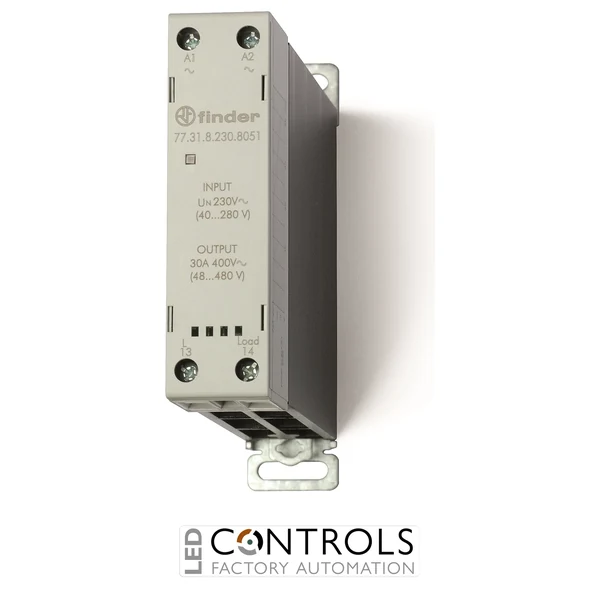
Why Choose the Finder 77.A2.9.024.8671 Dual-Phase Solid State Relay?
The Finder 77.A2.9.024.8671 is an industrial dual-phase solid state relay (SSR) designed for fast, silent and reliable switching of AC electrical loads. Part of the Finder 77 Series, this relay features two independently controlled normally open semiconductor outputs, making it suitable for industrial heating, motor control and automated machinery applications.
Featuring a 24 V DC nominal control voltage, an operating input range of 4–32 V DC and 25 A rated output current per channel, the Finder 77.A2.9.024.8671 allows compatible PLCs and electronic controllers to operate two AC switching circuits. Its 24–660 V AC switching voltage range supports a wide variety of industrial electrical systems.
Unlike zero-crossing solid state relays, this model uses random turn-on switching, allowing its outputs to activate without waiting for the next AC voltage zero crossing. This switching characteristic is particularly useful for suitable motor control and other applications where immediate semiconductor turn-on is required.
The relay incorporates a compact hockey puck-style housing, screw terminals, a folding protective terminal cover and a contactor-style terminal arrangement. It is designed for mounting on a suitable metal panel or heatsink, with appropriate thermal management for the connected loads.
Key Advantages
- Two independent output channels allow separate control of two AC switching circuits.
- 25 A rated output current per channel supports suitable industrial loads.
- 24–660 V AC switching range accommodates a wide range of AC supply voltages.
- 4–32 V DC control inputs provide compatibility with suitable PLC and electronic controller outputs.
- Random turn-on switching enables rapid activation without waiting for an AC voltage zero crossing.
- Silent semiconductor operation eliminates the mechanical clicking associated with electromechanical relays.
- No moving output contacts means no mechanical contact bounce or contact wear.
- High switching endurance makes the relay suitable for frequent operating cycles.
- Independent low-power control inputs simplify integration with automation equipment.
- Compact dual-channel construction combines two switching functions in one housing.
- Contactor-style terminal arrangement supports practical control panel wiring.
- Panel or heatsink mounting allows thermal management to be matched to the application.
Key Features
- Finder 77 Series dual-phase solid state relay.
- Two independent semiconductor output channels.
- 2 NO equivalent output configuration (DPST-NO).
- 25 A rated current per output channel.
- 600 V AC rated output voltage.
- 24–660 V AC operating switching range.
- 24 V DC nominal control voltage.
- 4–32 V DC control voltage range.
- Random turn-on switching mode.
- 47–400 Hz AC operating frequency range.
- 300 A maximum peak current for 10 ms, subject to the manufacturer's conditions.
- 5 mA specified off-state leakage current.
- Contactless semiconductor switching.
- Silent, spark-free and contact-bounce-free operation.
- Two independently driven low-power DC control inputs.
- Compact hockey puck-style enclosure.
- Folding screw terminal protection cover.
- Contactor-style terminal arrangement with input and output terminals on adjacent sides.
- Panel or heatsink mounting.
- −30 to +80 °C ambient operating temperature range, subject to thermal derating.
- Suitable for compatible heater and motor control applications.
Technical Specifications
- Manufacturer: Finder
- Series: 77 Series
- Model: 77.A2.9.024.8671
- Product type: Dual-phase solid state relay
- Relay construction: Hockey puck-style semiconductor relay
- Number of output channels: 2
- Output configuration: 2 NO equivalent (DPST-NO)
- Output control: Two independent DC control inputs
- Rated output current: 25 A per channel
- Maximum peak current: 300 A for 10 ms
- Rated output voltage: 600 V AC
- Operating load voltage: 24–660 V AC
- Output voltage type: AC
- Nominal control voltage: 24 V DC
- Operating control voltage: 4–32 V DC
- Control voltage type: DC
- Switching function: Random turn-on
- AC operating frequency: 47–400 Hz
- Off-state leakage current: 5 mA
- Operating temperature: −30 to +80 °C, subject to derating
- Mounting method: Metal panel or suitable heatsink
- Connection type: Screw terminals
- Terminal arrangement: Contactor-style
- Terminal protection: Folding screw cover
- Housing length: 58.4 mm
- Housing width: 45.7 mm
- Housing height: 46 mm
- Dimensions (L × W × H): 58.4 × 45.7 × 46 mm
- Compliance: RoHS compliant
- Approvals: CE, UKCA, EAC and cURus, according to product certification
Independent Dual-Channel Solid State Switching
The Finder 77.A2.9.024.8671 combines two semiconductor switching channels within one industrial relay housing. Each channel has its own low-power DC control input, allowing compatible control equipment to operate the outputs independently.
This arrangement can simplify electrical panel layouts where two AC loads or switching paths must be controlled separately. Rather than installing two individual single-channel solid state relays, engineers can use one dual-channel device, provided its electrical, thermal and installation requirements are satisfied.
The relay's 2 NO equivalent output configuration means both output channels are normally non-conducting until their respective control inputs are activated. However, because the outputs use semiconductor devices, they do not provide the same physical contact separation as an open electromechanical relay.
The 25 A output rating applies to each channel, subject to the manufacturer's thermal derating requirements. Operating both channels simultaneously increases total heat dissipation, making correct heatsink selection particularly important.
What Is Random Turn-On Switching?
The Finder 77.A2.9.024.8671 uses random turn-on switching, sometimes described as instantaneous switching. When a suitable DC control signal is applied, the corresponding semiconductor output can begin conducting without waiting for the next AC voltage zero crossing.
This differs from a zero-crossing SSR, which intentionally delays turn-on until the AC supply waveform approaches zero voltage.
Random turn-on switching can be advantageous for certain motor control applications, phase-control arrangements and other specialised AC switching duties. However, suitability depends on the electrical characteristics of the load and the control strategy being used.
For applications involving purely resistive heaters, zero-crossing relays may be preferable where minimising switching interference is the primary consideration. The appropriate switching method should therefore be selected according to the application rather than assuming that one type is suitable for every load.
Thermal Management and Installation Considerations
Solid state relays generate heat during operation because their semiconductor outputs have a voltage drop while conducting. The Finder 77.A2.9.024.8671 therefore requires appropriate thermal management, especially when both channels are carrying substantial current.
The relay is intended for mounting on a suitable metal panel or heatsink. Finder provides thermal derating information for this model, including reference data for installation on a heatsink with a thermal resistance of 0.9 K/W.
The permissible operating current depends on ambient temperature, heatsink performance, ventilation and whether one or both channels are energised. The full 2 × 25 A rating must not be assumed to apply under every installation condition.
Suitable upstream protection and a means of electrical isolation should be included in the installation. Because semiconductor outputs can pass a small leakage current when switched off, the relay must not be used as the sole means of safely isolating connected equipment.
The relay's DC control inputs are separate from its AC switching outputs. It is designed to switch AC loads and should not be selected for DC output switching.
Typical Applications
- Industrial heater and temperature control systems.
- Two-channel electric heating equipment.
- Industrial motor control applications within the specified ratings.
- Automated machinery requiring independent AC switching channels.
- PLC-controlled industrial electrical equipment.
- Packaging and manufacturing machinery.
- Process heating and thermal control installations.
- OEM electrical control panels.
- Industrial automation systems with frequent switching requirements.
- Compatible AC load control circuits.
- Machine building and equipment integration.
- Applications requiring silent, contactless switching of two AC circuits.