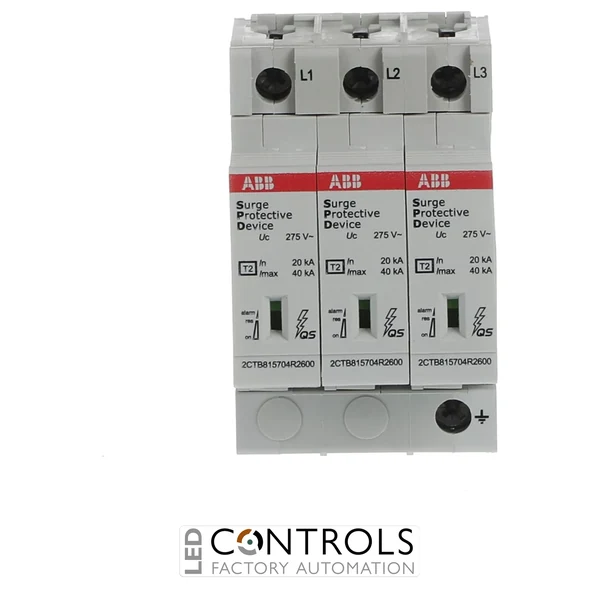
Why Choose the ABB OVR T2 3L 40-275s P QS Surge Protection Device?
The ABB OVR T2 3L 40-275s P QS, order code 2CTB815704R1800, is a pluggable Type 2 surge protection device (SPD) designed to protect three-phase low-voltage electrical installations against transient overvoltages caused by indirect lightning and electrical switching events. Part of the ABB OVR QuickSafe range, it combines high surge-discharge capability with ABB Safety Reserve technology for TN-C electrical distribution systems.
Designed for 230/400 V AC systems, the OVR T2 3L 40-275s P QS provides a 20 kA nominal discharge current (In) and a 40 kA maximum discharge current (Imax) with an 8/20 µs waveform. Its maximum continuous operating voltage (Uc) is 275 V AC, while the voltage protection level (Up) is 1.4 kV, helping limit transient voltages reaching downstream equipment.
The device incorporates ABB's Safety Reserve system, patented QuickSafe technology, an integrated thermal disconnector and an end-of-life indicator. Its pluggable three-pole construction enables straightforward cartridge replacement, while support for backup protection up to 160 A fuse or 125 A MCB makes it suitable for robust commercial, residential and industrial distribution-board applications.
Key Advantages
- Type 2 surge protection for three-phase low-voltage distribution systems.
- 40 kA maximum discharge current (Imax) with an 8/20 µs waveform.
- 20 kA nominal discharge current (In) with an 8/20 µs waveform.
- 1.4 kV voltage protection level (Up) helps limit transient overvoltages reaching downstream equipment.
- 275 V AC maximum continuous operating voltage.
- Safety Reserve technology supports continued protection and planned maintenance.
- Patented QuickSafe technology provides fast, reliable disconnection at end of life.
- Integrated thermal disconnector and end-of-life indicator simplify condition monitoring.
- Pluggable construction enables straightforward replacement of individual protection cartridges.
Key Features
- ABB OVR QuickSafe surge protection range.
- Type 2 / Class II surge protection device.
- Three-pole configuration with three protected lines.
- Designed for TN-C low-voltage distribution systems.
- 230 V AC rated voltage.
- 230/400 V AC nominal system voltage.
- 275 V AC maximum continuous operating voltage.
- 20 kA nominal discharge current (8/20 µs).
- 40 kA maximum discharge current (8/20 µs).
- 2 kA impulse current (10/350 µs).
- 1.4 kV voltage protection level.
- Safety Reserve system.
- Integrated thermal disconnector.
- Integrated end-of-life indicator.
- Preventive-maintenance functionality.
- Backup protection up to 160 A gG/gL fuse or 125 A curve B/C MCB.
- Fast response time of <25 ns.
- DIN rail mounting with three-module construction.
- IP20 protection rating.
Three-Phase Type 2 Protection with Safety Reserve Technology
Type 2 surge protection devices are designed to discharge transient currents generated by indirect lightning strikes and switching events that create induced or conducted overvoltages on low-voltage power distribution networks. They are commonly installed in main distribution switchboards and subdistribution boards, where their low residual voltage helps protect downstream electrical and electronic equipment.
The ABB OVR T2 3L 40-275s P QS combines a 40 kA maximum 8/20 µs discharge current with ABB's Safety Reserve and QuickSafe technologies. Its integrated status indication and preventive-maintenance functionality help identify when servicing is required, while the pluggable design allows the individual OVR T2 40-275s C QS phase cartridges to be replaced without replacing the complete SPD assembly.
Typical Applications
- 230/400 V AC TN-C electrical distribution systems.
- Three-phase low-voltage distribution boards.
- Main electrical distribution switchboards.
- Subdistribution boards.
- Residential and multi-residential electrical installations.
- Commercial building electrical systems.
- Industrial low-voltage distribution systems.
- Protection of sensitive electrical and electronic equipment.
- Protection against indirect lightning and switching-induced transient overvoltages.