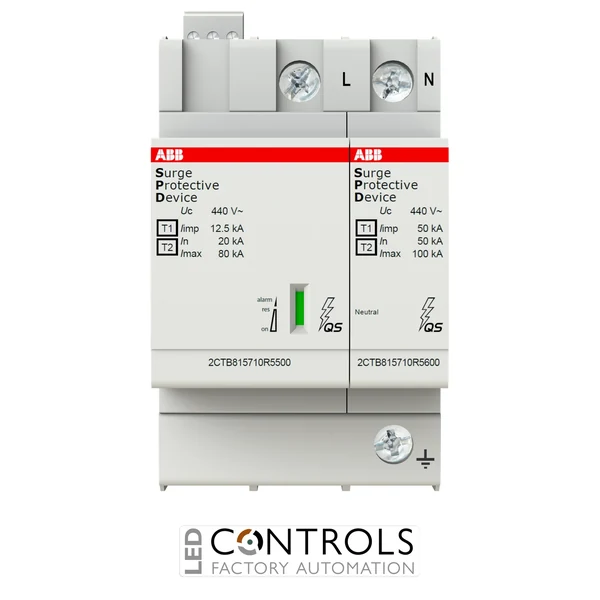
Why Choose the ABB OVR T1-T2 1N 12.5-440s P TS QS Surge Protective Device?
The ABB OVR T1-T2 1N 12.5-440s P TS QS, order code 2CTB815710R3000, is a combined Type 1 and Type 2 surge protective device (SPD) designed to protect low-voltage electrical installations against lightning currents and transient overvoltages. Part of the ABB OVR QuickSafe range, it provides coordinated lightning and surge protection for single-phase plus neutral systems and is suitable for integration with ABB System pro M compact installations.
The 1N configuration is designed for 1L+1N networks and is suitable for TT and TN-S systems. The device combines high-energy lightning-current handling with protection against lower-energy switching and indirect-lightning surges. Its pluggable construction simplifies maintenance, while the TS potential-free changeover contact enables remote monitoring of the surge protector's operating condition.
With a nominal system voltage of 400 V AC, maximum continuous operating voltage (Uc) of 440 V AC, 12.5 kA impulse current (Iimp) and 80 kA maximum discharge current (Imax), the OVR T1-T2 1N 12.5-440s P TS QS provides substantial surge-handling capability. Its 1.9 kV voltage protection level (Up) helps limit transient voltage reaching downstream electrical and electronic equipment.
Key Advantages
- Combined Type 1 and Type 2 surge protection in a single coordinated device.
- 12.5 kA impulse current (Iimp) capability for 10/350 µs lightning-current impulses.
- 80 kA maximum discharge current (Imax) for high transient-current capability.
- 20 kA nominal discharge current (In) for 8/20 µs surge currents.
- 440 V AC maximum continuous operating voltage (Uc).
- 1.9 kV voltage protection level (Up) helps protect downstream equipment.
- 1L+1N configuration suitable for TT and TN-S electrical systems.
- TS remote signalling contact enables external condition monitoring.
- Pluggable QuickSafe construction simplifies servicing and replacement.
Key Features
- ABB OVR T1-T2 QuickSafe surge protective device series.
- Combined Type 1 + Type 2 SPD.
- 1N / 1L+1N configuration.
- Nominal system voltage (Un): 400 V AC.
- Maximum continuous operating voltage (Uc): 440 V AC.
- Impulse current (Iimp, 10/350 µs): 12.5 kA.
- Maximum discharge current (Imax, 8/20 µs): 80 kA.
- Nominal discharge current (In, 8/20 µs): 20 kA.
- Voltage protection level (Up): 1.9 kV.
- Suitable for TT and TN-S network configurations.
- QuickSafe Safety Reserve technology provides continued basic protection prior to replacement at end of life.
- Pluggable, replaceable surge-protection cartridges.
- TS potential-free changeover contact for remote signalling.
- DIN-rail mounting and System pro M compact compatibility.
- IP20 degree of protection.
Combined Lightning and Surge Protection for Low-Voltage Systems
Type 1 surge protective devices are designed to discharge high-energy lightning currents entering an electrical installation, while Type 2 protection limits lower-energy transient overvoltages generated by indirect lightning effects and electrical switching. The ABB OVR T1-T2 1N 12.5-440s P TS QS combines both functions to provide coordinated protection for appropriate single-phase plus neutral distribution systems.
ABB QuickSafe technology adds practical maintenance benefits to this protection. The Safety Reserve design maintains a basic level of surge protection when the main protection element reaches end of life, giving maintenance personnel an opportunity to replace the affected cartridge. The integrated TS contact also allows SPD status to be incorporated into remote monitoring and building or industrial control systems.
Typical Applications
- Single-phase plus neutral TT electrical systems.
- Single-phase plus neutral TN-S electrical systems.
- Main distribution boards requiring combined Type 1 and Type 2 protection.
- Commercial and industrial electrical installations.
- Buildings equipped with external lightning protection systems.
- Electrical distribution panels requiring remote SPD status monitoring.
- Installations exposed to lightning-current and switching transient overvoltages.