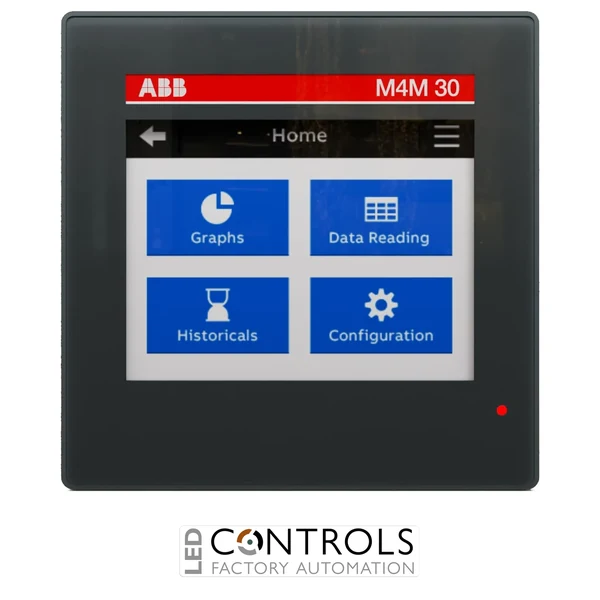
Why Choose the ABB M4M 30 MODBUS Network Analyzer?
The ABB M4M 30 MODBUS, order code 2CSG274761R4051, is an advanced three-phase network analyzer designed for comprehensive electrical parameter monitoring, energy measurement and power quality analysis in commercial and industrial electrical systems. As part of the ABB M4M 30 network analyzer series, it combines Class 0.5S energy accuracy with advanced diagnostic functions for detailed analysis of electrical distribution networks.
The M4M 30 MODBUS provides Modbus RTU over RS485 and integrated Bluetooth Low Energy (BLE) communication, allowing integration with energy management and automation systems while supporting convenient smart commissioning. Its colour touchscreen display simplifies access to measured data and configuration, while four programmable I/O channels provide flexible interfacing with external equipment.
Designed for three-phase, four-wire electrical networks, the analyzer supports a voltage measurement range of 50–400 V AC and indirect current measurement using 1 A or 5 A current transformers. Advanced M4M 30 functionality includes neutral current measurement, individual harmonic analysis up to the 40th harmonic, waveform capture, phasor diagrams and 32 MB of onboard memory for event and measurement data.
Key Advantages
- Advanced three-phase power and energy monitoring for industrial and commercial electrical systems.
- Modbus RTU over RS485 for integration with automation, energy management and supervisory systems.
- Integrated Bluetooth Low Energy (BLE) for smart commissioning and configuration.
- Class 0.5S active energy accuracy for dependable energy measurement.
- Advanced power quality analysis including THD and individual harmonics up to the 40th harmonic.
- Waveform capture and phasor diagram functions support detailed electrical system analysis.
- Four programmable I/O channels provide flexible interfacing with external equipment.
- Direct neutral current measurement provides additional visibility in three-phase, four-wire systems.
Key Features
- ABB M4M 30 network analyzer series.
- Three-phase, four-wire network measurement.
- 50–400 V AC voltage measurement range.
- Indirect current measurement using 1 A or 5 A current transformers.
- 48–240 V AC/DC auxiliary supply.
- Modbus RTU communication via RS485.
- Integrated Bluetooth Low Energy (BLE) communication.
- Four programmable I/O channels.
- Colour 3.5-inch LCD touchscreen.
- True RMS electrical measurement.
- Measurement of voltage, current, frequency, power factor, active, reactive and apparent power and energy.
- Four-quadrant energy measurement for consumption and generation monitoring.
- Voltage and current total harmonic distortion (THD) measurement.
- Individual harmonic analysis up to the 40th harmonic.
- Neutral current measurement.
- Waveform capture and phasor diagram functionality.
- 32 MB onboard memory for data and event recording.
- Maximum, minimum and average demand monitoring.
- IP54 front protection for panel-mounted installations.
Advanced Power Quality and Energy Monitoring
Network analyzers such as the ABB M4M 30 MODBUS provide detailed visibility of electrical consumption, load conditions and power quality within distribution systems. In addition to standard voltage, current, power and energy measurements, the M4M 30 provides advanced diagnostic functions including harmonic analysis, waveform capture, phasor diagrams and neutral current monitoring.
The M4M 30 series is designed for applications where detailed electrical data is required for energy efficiency, maintenance and power quality assessment. Modbus RTU communication enables measured information to be integrated into PLCs, building management systems and energy management platforms, while Bluetooth connectivity and the colour touchscreen simplify local commissioning, configuration and analysis.
Typical Applications
- Industrial electrical distribution systems.
- Low-voltage switchboards and control panels.
- Commercial building energy monitoring.
- Power quality monitoring and analysis.
- Factory and production facility power monitoring.
- Energy efficiency and consumption analysis.
- Building management and automation systems.
- Electrical load, demand and harmonic analysis.
- Renewable generation and bidirectional energy monitoring.
- Preventive maintenance and electrical system diagnostics.