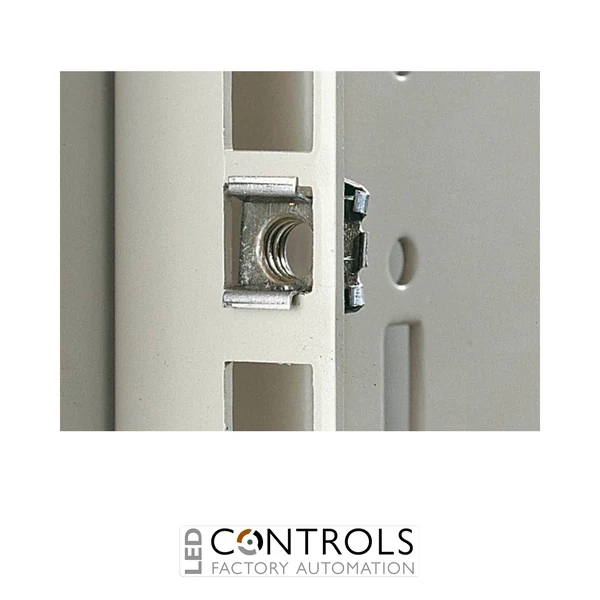
Why Choose the Rittal EL2092.500 Captive Nut M5?
The Rittal EL2092.500 is a reliable M5 captive nut without contact designed for secure mechanical fastening within Rittal enclosure systems. As part of the Rittal mounting accessory range, it provides a practical solution for creating threaded fixing points for enclosure components, accessories and internal assemblies.
This captive nut simplifies installation by remaining securely positioned within the mounting location during assembly. Its retained design helps improve efficiency when fitting enclosure components while providing a dependable threaded connection for professional electrical and industrial installations.
The EL2092.500 is designed for use with metal thicknesses of 0.8–2 mm and provides an M5 thread size. It is suitable for Rittal enclosure applications where reliable and efficient component mounting is required.
Key Advantages
- Reliable M5 captive nut solution for enclosure assemblies.
- Designed for metal thicknesses of 0.8–2 mm.
- Captive design keeps the nut securely retained during installation.
- Provides a practical threaded fixing point for enclosure components.
- Compatible with Rittal mounting and assembly systems.
- Supports efficient panel building and enclosure modification.
Key Features
- Rittal enclosure accessory range.
- M5 thread size.
- Captive nut design without contact.
- Suitable metal thickness: 0.8–2 mm.
- Designed for secure mechanical fastening.
- Suitable for electrical enclosure assembly applications.
Reliable Mounting Solutions for Industrial Enclosures
Rittal captive nuts provide secure and efficient fastening solutions for electrical enclosure construction. Their practical design supports faster installation while maintaining reliable mechanical connections for internal components and accessories.
The EL2092.500 is suitable for panel builders, electrical engineers and system integrators requiring dependable enclosure hardware for industrial control and automation applications.
Typical Applications
- Rittal electrical enclosures.
- Industrial control cabinets.
- Internal enclosure component mounting.
- Panel building and assembly applications.
- Automation and electrical installation projects.
- Mechanical fastening within enclosure systems.