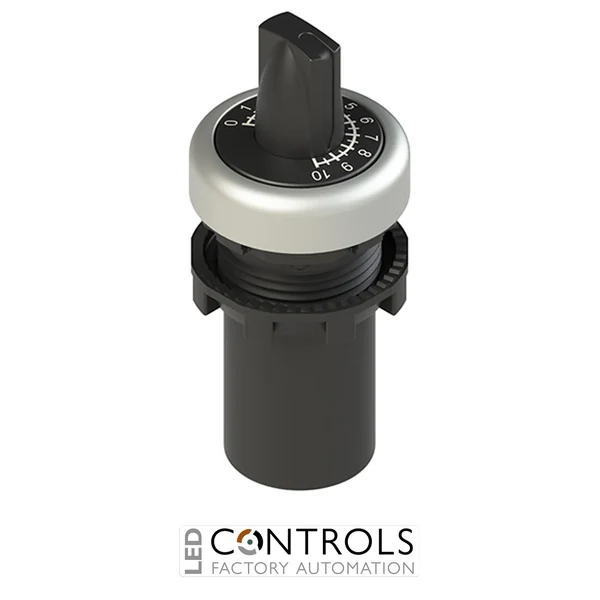
Pizzato E61DM001K-D319 Potentiometer E6 Series 1kΩ Cermet Rotary Control
Why Choose the Pizzato E61DM001K-D319 Potentiometer?
The Pizzato E61DM001K-D319 is a precision rotary potentiometer from the E6 DM series,
designed for reliable analogue adjustment and control applications in industrial automation
systems. Featuring a 1 kΩ resistance value and a durable cermet resistive element, this
potentiometer provides stable performance, accurate adjustment and long operational life.
Designed for Ø22 mm industrial control panel mounting, the E61DM001K-D319 features
PUSH-IN spring terminals for fast and secure wiring, along with a satin chrome ring finish
for a professional and robust installation.
Key Advantages
- Accurate analogue signal adjustment for industrial control systems.
- 1 kΩ resistance value for precise parameter control.
- Cermet resistive element for excellent stability and durability.
- PUSH-IN spring terminals for quick and reliable connection.
- Designed for Ø22 mm panel mounting applications.
- Suitable for demanding industrial environments.
Key Features
- Pizzato E6 DM series potentiometer.
- Model: E61DM001K-D319.
- Resistance: 1 kΩ.
- Potentiometer type: Cermet 0.5 W.
- Connection type: PUSH-IN type spring terminals.
- Ring finish: Satin chrome.
- Rotary adjustment design for smooth analogue control.
- Industrial panel mounting format.
Reliable Analogue Control for Industrial Systems
Potentiometers provide operators and engineers with a simple and effective method of
adjusting analogue signals within machinery and automation equipment. The Pizzato
E61DM001K-D319 delivers dependable manual control for applications requiring accurate
resistance adjustment and consistent operation.
With its compact design, robust construction and industrial-grade components, this Pizzato
E6 series potentiometer is ideal for integration into control panels, machine interfaces and
OEM equipment where reliable analogue adjustment is required.
Typical Applications
- Industrial control panels.
- Machine interface controls.
- Automation equipment adjustment.
- Process parameter calibration.
- OEM machinery integration.
- Analogue input control applications.