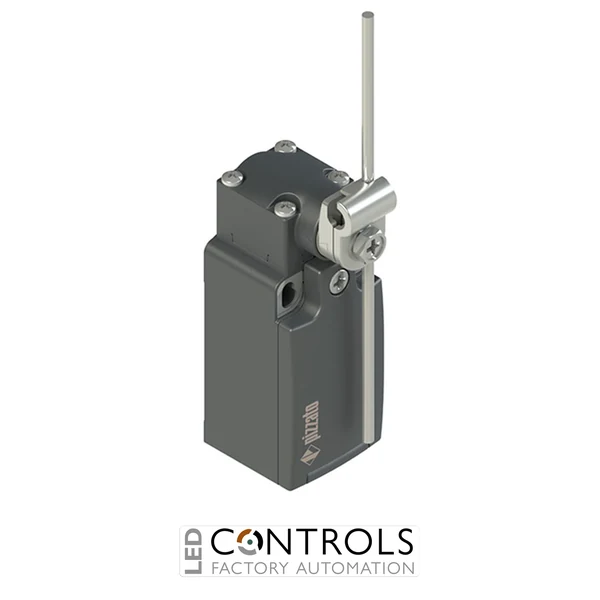
Why Choose the Pizzato FR2250 Position Limit Switch?
The Pizzato FR2250 is a versatile and durable position limit switch designed for accurate detection of mechanical movement in industrial automation systems. As part of the reliable Pizzato FR series, it offers consistent switching performance and long-term reliability in demanding environments.
This model features a robust technopolymer housing and an adjustable stainless steel round rod lever, enabling flexible installation and precise actuation across a wide range of industrial machinery. Its compact yet rugged design ensures dependable operation in harsh conditions.
Equipped with a slow-action contact system and a 2 normally open (NO) + 1 normally closed (NC) contact configuration, the FR2250 provides flexible control options for both signalling and safety-related applications.
Key Advantages
- Reliable position switch for industrial automation.
- 2 NO + 1 NC contacts for versatile control circuits.
- Durable technopolymer housing for industrial environments.
- Adjustable rod lever actuator for flexible installation.
- Stable and repeatable slow-action switching.
- High mechanical durability for long service life.
Key Features
- Pizzato FR series position switch.
- 2 NO + 1 NC slow-action contacts.
- Adjustable stainless steel round rod lever (approx. 3 × 125 mm).
- Technopolymer enclosure for industrial durability.
- PG13.5 cable entry for standard wiring.
- IP67 protection rating.
- Silver contacts for reliable conductivity.
- No reset function (standard configuration).
Reliable Position Detection for Industrial Systems
Position limit switches such as the Pizzato FR2250 are essential for detecting the movement or position of machine components. They enable precise control of automated processes, ensuring correct sequencing and safe operation of industrial equipment.
The combination of 2 NO and 1 NC contacts provides increased flexibility, allowing simultaneous signalling and control functions within a single compact device.
Typical Applications
- Position detection in industrial machinery.
- Conveyor and material handling systems.
- Packaging and assembly lines.
- Automation and process control systems.
- Mechanical end-of-travel detection.
- OEM machine building and integration.