Why Choose the Lovato KBH1A11 Limit Switch?
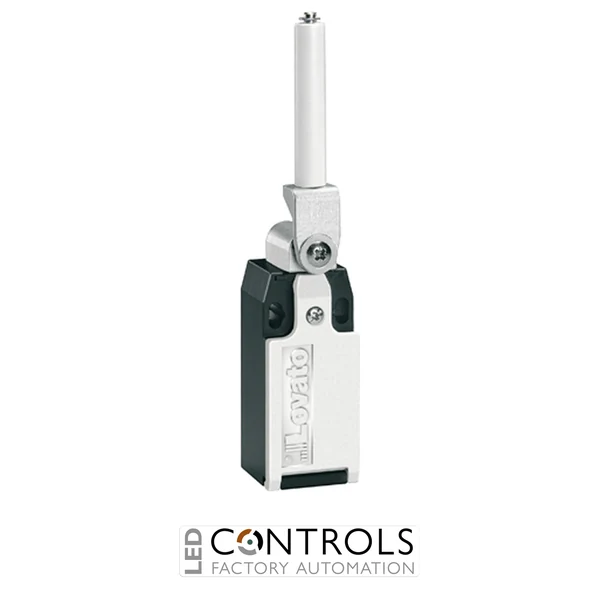
The Lovato KBH1A11 is an industrial K series limit switch with a ceramic rod lever, designed for position detection and motion monitoring in machinery and automated equipment. Its dimensions conform to EN 50047, supporting straightforward integration into standard industrial installations.
This limit switch features a 1NO+1NC slow-action, make-before-break contact arrangement. During actuation, the normally open contact closes before the normally closed contact opens, providing a brief contact overlap for suitable machine-control and sequencing circuits.
The KBH1A11 uses a double-insulated thermoplastic housing with IP65 body protection and a bottom M20 cable entry. Its ceramic rod actuator can be contacted from different approach directions, making the switch suitable for detecting moving products, machine components and irregular travel paths.
Key Advantages
- Industrial limit switch with ceramic rod lever.
- 1NO+1NC slow-action contacts support control and monitoring circuits.
- Make-before-break operation provides intentional contact overlap during actuation.
- IP65 thermoplastic housing provides protection against dust and water jets.
- EN 50047 dimensions simplify installation and replacement.
- Bottom M20 cable entry supports convenient machine wiring.
Key Features
- Lovato K series industrial limit switch.
- Ceramic rod-lever actuator.
- 1 normally open and 1 normally closed contact.
- Slow-action, make-before-break contact operation.
- Direct opening action of the normally closed contact.
- Double-insulated polymer thermoplastic housing.
- Locking bayonet operating-head insert.
- Self-releasing screw terminals.
- M20 bottom cable entry.
Reliable Position Detection for Industrial Machinery
Limit switches convert the physical movement of a machine component or product into an electrical contact signal. The ceramic rod on the Lovato KBH1A11 provides an extended actuation surface for detecting objects whose movement may not align with a conventional plunger or roller lever.
The make-before-break mechanism closes the normally open contact before opening the normally closed contact during actuator travel. This overlapping contact sequence can support control circuits that require continuity or a defined transition between two switching states.
Typical Applications
- Machine position and travel detection.
- Conveyors and material-handling systems.
- Product-presence and passage detection.
- Packaging and processing machinery.
- Automated production and assembly equipment.
- Moving components with variable approach paths.