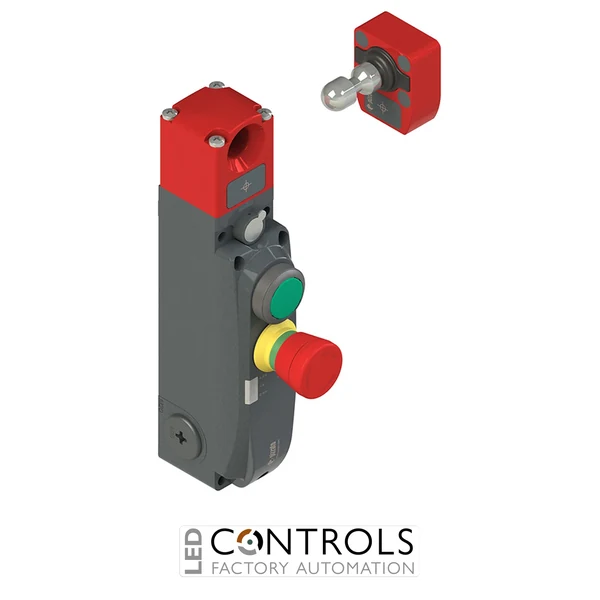
Why Choose the Pizzato NG 2D1E411O-F31 Safety Switch?
The Pizzato NG 2D1E411O-F31 is an RFID safety switch with guard locking and integrated control devices designed for protected access points on industrial machinery and automated equipment. Part of the Pizzato NG series, it combines coded actuator detection, electronic safety outputs and guard locking within a robust metal housing.
The NG 2D1E411O-F31 uses working method E, meaning the actuator is locked when the solenoid is energised. Its OS1 and OS2 safety outputs operate according to activation mode 1 and are active when the actuator is inserted and locked. Dedicated O3 and O4 signalling outputs indicate actuator insertion and locking status, providing useful feedback for compatible machine safety and automation systems.
Supplied complete with the VN NG-F31 high-coding-level RFID actuator, this configuration provides enhanced protection against inappropriate actuator substitution. The switch offers a substantial 9750 N locking force, a rotating head, metal housing and three threaded M20 × 1.5 conduit entries, while its integrated control-device configuration provides local machine-interface functionality at the guarded access point.
Key Advantages
- Combines RFID guard monitoring, guard locking and integrated control devices in one industrial safety device.
- Supplied complete with a VN NG-F31 high-coding-level actuator.
- 9750 N locking force provides substantial retention of machine guards and safety doors.
- Working method E locks the actuator when the solenoid is energised.
- Activation mode 1 provides active OS1 and OS2 safety outputs when the actuator is inserted and locked.
- Dedicated O3 signalling output indicates actuator insertion status.
- Dedicated O4 signalling output indicates actuator locking status.
- Integrated control devices allow operator functions to be located directly at the guarded access point.
- IP65 protection according to EN 60529 supports demanding industrial installations.
Key Features
- Pizzato NG series safety switch with guard locking.
- Electronic guard monitoring using RFID actuator technology.
- VN NG-F31 high-coding-level actuator included.
- 9750 N locking force.
- E working method with actuator locked by an energised solenoid.
- 2 safety inputs IS1-IS2.
- 2 safety outputs OS1-OS2.
- O3 signalling output for actuator inserted status.
- O4 signalling output for actuator locked status.
- I4 or IE1-IE2 inputs for solenoid activation.
- I3 input for actuator programming / reset.
- Activation mode 1, with safety outputs active when the actuator is inserted and locked.
- Integrated control devices for local machine-interface functions.
- Rotating head for flexible installation orientation.
- Metal housing with three threaded M20 × 1.5 conduit entries.
- Connection configuration without connector.
- Status indication for convenient machine safety diagnostics.
High-Coding RFID Guard Locking for Industrial Machinery
The Pizzato NG 2D1E411O-F31 combines RFID-based guard detection with an energised-solenoid locking principle. The VN NG-F31 actuator provides a high coding level, while the 9750 N locking mechanism provides substantial guard retention. With activation mode 1, the OS1 and OS2 safety outputs are active when the actuator is both inserted and locked.
Separate O3 and O4 signalling outputs provide information about actuator insertion and locking status, helping compatible machine control systems distinguish between guard conditions. Combining these functions with integrated operator controls can simplify guarded machine-access installations by bringing safety monitoring, locking and local machine-interface functionality together in one device.
Typical Applications
- Industrial machine guards and safety doors.
- Robotic cells and automated production systems.
- Packaging and processing machinery.
- Automated assembly and manufacturing equipment.
- Machine tools and production equipment.
- Guarded access points requiring integrated operator controls.
- Machinery requiring high-force guard retention.
- Industrial safety and factory automation systems.