Why Choose the Pizzato NG 2D5D413G-F30 Safety Switch with Lock?
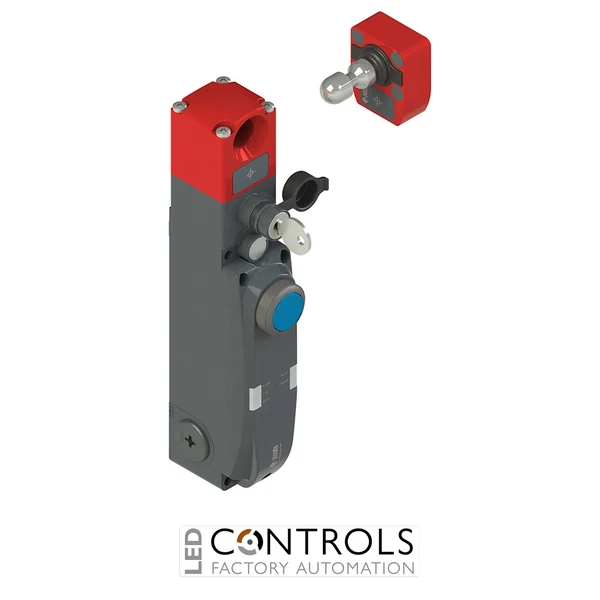
The Pizzato NG 2D5D413G-F30 is an advanced NG series RFID safety switch with guard locking and an integrated control device, supplied complete with the VN NG-F30 actuator. Designed for industrial machine guarding, it combines electronic actuator monitoring, electromagnetic guard locking and local operator control within a robust powder-coated metal housing.
This configuration uses the D working principle, meaning the actuator is locked while the locking electromagnet is de-energised. Its Mode 1 safety logic activates the OS1 and OS2 safety outputs when the actuator is inserted and locked, while dedicated O3 and O4 signalling outputs provide actuator-inserted and actuator-locked status information.
The NG 2D5D413G-F30 incorporates a single blue pushbutton with 1NO + 1NC contacts and an orientable head with auxiliary key release. It is supplied complete with the VN NG-F30 low-coding-level actuator and provides a maximum holding force of 9750 N, making it a comprehensive solution for guarded machinery requiring local operator control and controlled access.
Key Advantages
- Combines RFID guard monitoring, electromagnetic locking and local operator control in one device.
- Supplied complete with the VN NG-F30 low-coding-level actuator.
- 9750 N maximum holding force provides robust guard retention.
- D working principle retains the actuator while the locking electromagnet is de-energised.
- Mode 1 safety logic activates the safety outputs when the actuator is inserted and locked.
- Integrated blue pushbutton with 1NO + 1NC contacts provides convenient local operator control.
- Auxiliary key release provides manual unlocking capability where required by the machine design.
- Separate O3 and O4 signalling outputs provide actuator-position and locking-status information.
- Robust powder-coated metal housing supports demanding industrial installations.
Key Features
- Pizzato NG series RFID safety switch with electromagnetic guard locking.
- VN NG-F30 actuator included.
- Low coding level according to EN ISO 14119.
- D working principle – actuator locked with electromagnet de-energised.
- 24 V DC ±10% nominal operating voltage.
- 9750 N maximum holding force.
- Cover configuration: 1 integrated control device.
- Position 1: blue pushbutton, 1NO + 1NC.
- 2 safety inputs: IS1 and IS2.
- 2 safety outputs: OS1 and OS2.
- Mode 1: safety outputs active with actuator inserted and locked.
- O3 signalling output indicates actuator inserted.
- O4 signalling output indicates actuator locked.
- I4 or IE1-IE2 inputs provide electromagnet activation control.
- I3 provides actuator programming / reset functionality.
- Orientable head with auxiliary key release.
- No emergency release.
- Metal, powder-coated housing.
- Three M20 × 1.5 threaded cable entries.
- IP65 protection according to EN 60529 for the integrated-control configuration.
- Without connector connection configuration.
RFID Guard Monitoring with De-Energised Locking
The Pizzato NG 2D5D413G-F30 combines RFID actuator detection with electromagnetic guard locking so that a machine-safety system can monitor a movable guard while controlling access to hazardous areas. Its D working principle retains the actuator while the locking electromagnet is de-energised, while Mode 1 logic activates the OS1 and OS2 safety outputs when the actuator is both inserted and locked.
An auxiliary key-release mechanism is incorporated into the orientable head to provide manual release of the locking mechanism when required by the machine design. Combined with the VN NG-F30 low-coded actuator, integrated blue pushbutton and independent actuator-status outputs, this configuration provides a versatile guard-access solution for automated industrial machinery.
Typical Applications
- Industrial machine guard doors and access panels.
- Robotic cells and automated manufacturing systems.
- Packaging and processing machinery.
- Automated assembly and production lines.
- Conveyor and material-handling systems.
- Machine tools and production equipment.
- Guarding systems requiring de-energised electromagnetic locking.
- Machinery requiring auxiliary key-release functionality.
- Guarded access points requiring an integrated local pushbutton.
- Machine-safety systems requiring separate actuator and lock-status signalling.