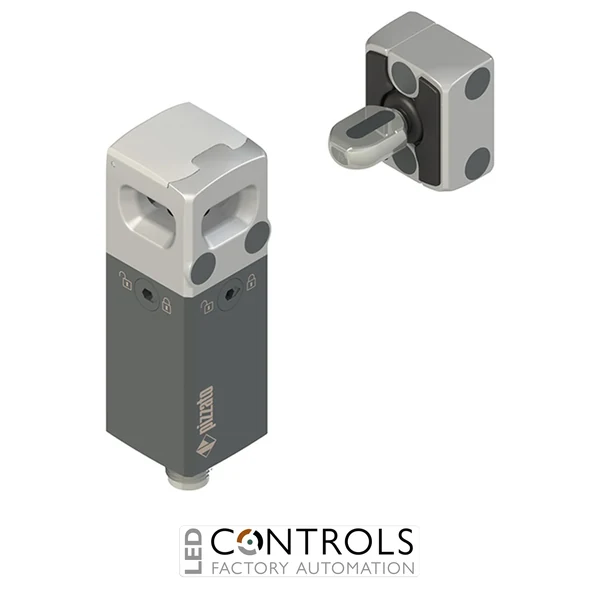
Why Choose the NXB42CZ1SPK-F61
The Pizzato Elettrica NXB42CZ1SPK-F61 is a robust RFID safety switch with lock from the NX series, engineered for demanding industrial safety applications. It utilises Mode 1 of bistable solenoid operation, providing actuation and monitoring through dedicated safety and signalling outputs, and incorporates solenoid activation and reset functionality.
Designed for harsh environments, this device offers a high protection rating of IP67 (EN 60529) and IP69K (ISO 20653), suitable for installations requiring resistance to dust and high-pressure cleaning. Reliable connection is assured via an M12, 8-pole connector for stand-alone applications, while recognised international certificates support its use across regulated markets.
Key Benefits
- Bistable solenoid (Mode 1): Secure locking with monitored actuator presence
- Comprehensive interface: 2 safety outputs (OS1, OS2), 1 signalling output (O3), plus dedicated inputs
- High ingress protection: Rated IP67 and IP69K for challenging industrial environments
- M12 connection: 8-pole connector for simple and secure wiring
- Certified global standards: cULus, EAC, ECOLAB, TÜV SÜD, UKCA, and EU compliance
What’s Included
- NXB42CZ1SPK-F61 RFID safety switch with lock
- Documentation via manufacturer website
Applications
- Machine guard locking and safety monitoring
- Food, beverage, and high-washdown production lines requiring high IP protection
- Automated cells and robotic safety interlocks
- Installations subject to international certification or inspection
Operation and Wiring
The NXB42CZ1SPK-F61 is configured for Mode 1 operation: when the actuator is inserted and locked, safety outputs OS1 and OS2 are activated. Inputs for solenoid activation and reset enable flexible integration with a range of safety control architectures. For commissioning and wiring, refer to the official manufacturer documentation and certifications.
Maintenance and Inspection
Suitable for use in frequent washdown and challenging environments. When deployed, regular checks should include verification of mechanical locking, connection integrity, and functional safety performance as part of scheduled maintenance. All servicing should comply with the relevant installation and safety standards.