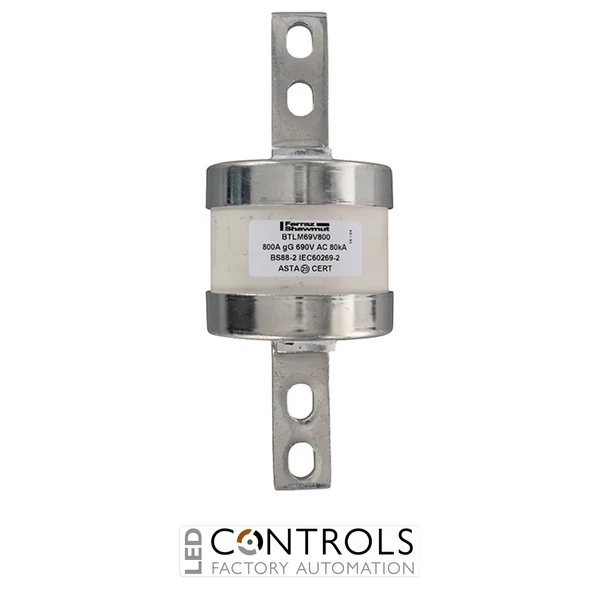
Why Choose the Mersen BTLM69V800 High-Current Fuse-Link?
The Mersen BTLM69V800 is a high-current industrial fuse-link intended to provide dependable overcurrent and short-circuit protection in low-voltage power distribution systems. Manufactured by Mersen, it is suited to demanding installations where substantial electrical loads and high prospective fault currents require reliable circuit protection.
This fuse-link helps protect cables, busbars, switchgear and connected electrical equipment by interrupting excessive current during qualifying fault conditions. Its high-current construction makes it suitable for use within industrial distribution panels, switchboards, machinery installations and other heavy-duty electrical assemblies.
The BTLM69V800 product designation indicates an 800 A nominal current rating and a voltage class of up to 690 V AC. Compatibility with the intended fuse holder, mounting arrangement, circuit voltage, breaking-capacity requirement and equipment manufacturer's specifications should be confirmed before installation.
Key Advantages
- High-current industrial fuse-link for power distribution protection.
- 800 A nominal current rating for substantial electrical loads.
- Voltage class suitable for systems operating at up to 690 V AC.
- Helps protect cables, busbars, switchgear and connected equipment.
- Current-limiting operation helps reduce damaging fault energy.
- Suitable for heavy-duty commercial and industrial installations.
Key Features
- Mersen BTLM industrial fuse-link series.
- 800 A nominal current rating.
- 690 V AC voltage class.
- Designed for overcurrent and short-circuit protection.
- Suitable for high-current power distribution circuits.
- Current-limiting fuse operation.
- Non-resettable protective element.
- Intended for installation in compatible industrial fuse gear.
Reliable Protection for High-Current Distribution Systems
High-current fuse-links such as the Mersen BTLM69V800 are used to interrupt severe electrical faults before conductors, busbars or connected equipment sustain extensive thermal or mechanical damage. When current exceeds the fuse-link's operating characteristic, the internal fuse element melts and isolates the affected circuit.
The current-limiting characteristics of an appropriately selected fuse can reduce the peak current and energy that downstream equipment experiences during a short circuit. This can help improve coordination with switchgear and reduce stress on electrical components within the protected installation.
Correct fuse selection should consider continuous load current, ambient temperature, enclosure conditions, cable capacity, prospective short-circuit current and coordination with upstream and downstream protective devices.
Typical Applications
- Industrial power distribution switchboards.
- High-current feeder and submain circuits.
- Busbar and cable protection.
- Manufacturing and processing facilities.
- Large machinery and plant installations.
- OEM electrical distribution assemblies.