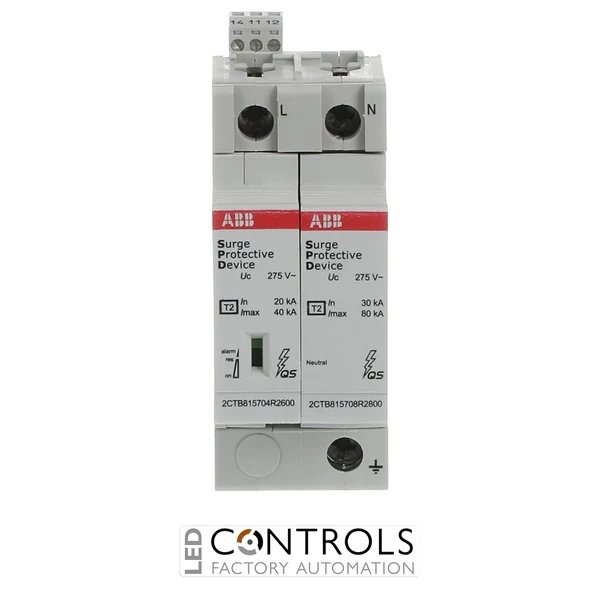
Why Choose the ABB OVR T2 1N 40-275s P TS QS Surge Protection Device?
The ABB OVR T2 1N 40-275s P TS QS, order code 2CTB815704R0200, is a pluggable Type 2 surge protection device (SPD) designed to protect low-voltage electrical installations against transient overvoltages caused by indirect lightning and electrical switching events. Part of the ABB OVR QuickSafe range, it is configured for single-phase plus neutral protection in compatible TT and TN-S electrical systems.
Designed for 230/400 V AC systems, the OVR T2 1N 40-275s P TS QS provides a 20 kA nominal discharge current (In) and a 40 kA maximum discharge current (Imax) with an 8/20 µs waveform. Its maximum continuous operating voltage is 275 V AC, while the voltage protection level is 1.4 kV across the protected modes.
The “s” Safety Reserve design incorporates a reserve varistor so that basic surge protection can remain available when the primary protection element reaches the end of its service life. The TS version provides remote signalling through auxiliary contacts, while visual status indication, preventive-maintenance functionality and pluggable QuickSafe construction support convenient monitoring and servicing.
Key Advantages
- Type 2 surge protection for low-voltage consumer and distribution systems.
- 40 kA maximum discharge current (Imax) with an 8/20 µs waveform.
- 20 kA nominal discharge current (In) with an 8/20 µs waveform.
- 1.4 kV voltage protection level (Up) helps limit transient voltage reaching downstream equipment.
- 275 V AC maximum continuous operating voltage.
- Safety Reserve technology provides additional protection capability at the end of the primary varistor's service life.
- Remote signalling contacts allow SPD condition monitoring through external systems.
- Visual status indication and preventive-maintenance functionality simplify condition monitoring.
- Pluggable QuickSafe construction supports straightforward cartridge replacement.
Key Features
- ABB OVR QuickSafe surge protection range.
- Type 2 / Class II surge protection device.
- 1+N configuration with two protected poles.
- Suitable for TT and TN-S distribution systems.
- 230 V AC nominal voltage.
- 230/400 V AC nominal system voltage.
- 275 V AC maximum continuous operating voltage.
- 20 kA nominal discharge current (8/20 µs).
- 40 kA maximum discharge current (8/20 µs).
- 1.4 kV voltage protection level.
- Safety Reserve varistor technology.
- Visual status indication.
- Preventive-maintenance function.
- 1 NO + 1 NC auxiliary contacts for remote signalling.
- 100 kA short-circuit withstand capability.
- DIN rail mounting with two-module construction.
- IP20 protection rating.
- Pluggable QuickSafe construction for convenient maintenance.
Type 2 Surge Protection with Safety Reserve Technology
Type 2 surge protection devices are designed to limit transient overvoltages caused primarily by indirect lightning effects and electrical switching operations. They can be installed in distribution boards and coordinated throughout an electrical installation to help prevent damaging transient voltages from reaching sensitive electrical and electronic equipment.
The ABB OVR T2 1N 40-275s P TS QS incorporates Safety Reserve technology. Rather than completely disconnecting surge protection when the primary varistor reaches the end of its service life, the reserve design retains a smaller protection element that continues to provide basic protection until the SPD can be replaced. Combined with visual indication, preventive-maintenance functionality and remote signalling, this provides clear information for planned maintenance.
Typical Applications
- 230/400 V AC TT electrical distribution systems.
- 230/400 V AC TN-S electrical distribution systems.
- Single-phase plus neutral surge protection.
- Residential electrical distribution boards.
- Commercial building distribution systems.
- Industrial low-voltage electrical installations.
- Subdistribution boards and distribution outlets.
- Installations requiring remote SPD status signalling.
- Protection against indirect lightning and switching-induced transient overvoltages.