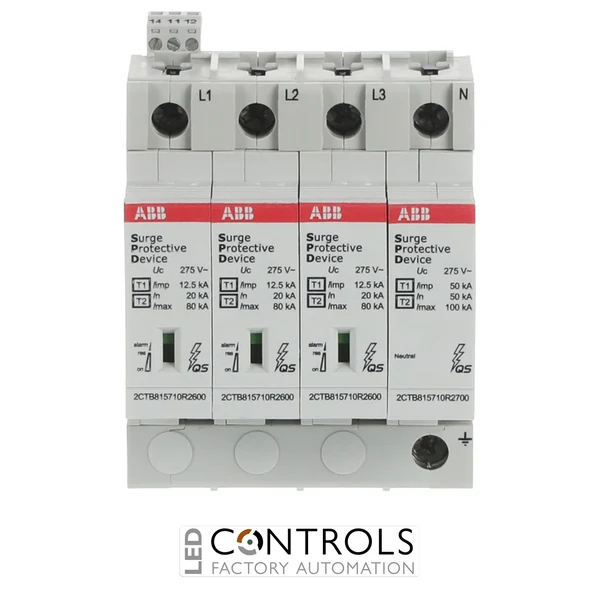
Why Choose the ABB OVR T1-T2 3N 12.5-275s P TS QS Surge Protective Device?
The ABB OVR T1-T2 3N 12.5-275s P TS QS is a high-performance combined Type 1 + Type 2 surge protective device (SPD) designed to protect three-phase low-voltage electrical installations against lightning currents and transient overvoltages. Identified by ABB order code 2CTB815710R0700, it forms part of the ABB OVR QuickSafe surge protection range and combines lightning-current protection with low residual voltage protection in a single DIN-rail-mounted assembly.
Designed for 3L+N TT and TN-S electrical systems, this four-line SPD provides an impulse current rating of 12.5 kA per pole using a 10/350 µs waveform, together with an 80 kA maximum discharge current and 20 kA nominal discharge current. ABB's patented QuickSafe technology, integrated thermal disconnection and Safety Reserve system provide dependable operation while supporting preventive maintenance and reduced downtime.
The OVR T1-T2 3N 12.5-275s P TS QS is designed for 230/400 V AC systems with a 275 V AC maximum continuous operating voltage on L-N. Its pluggable construction simplifies servicing, while the TS auxiliary signalling contact enables remote monitoring of surge-protection status in industrial, commercial and building distribution systems.
Key Advantages
- Combined Type 1 + Type 2 surge protection in a single device.
- 12.5 kA impulse current (Iimp, 10/350 µs) per pole for lightning-current protection.
- 50 kA total impulse current across the four-line configuration.
- 80 kA maximum discharge current (Imax) for high-energy transient protection.
- Designed for 3L+N TT and TN-S electrical distribution systems.
- Patented ABB QuickSafe technology with integrated thermal disconnection.
- Safety Reserve system supports extended protection availability and preventive maintenance.
- TS remote signalling provides auxiliary NO/NC contacts for remote status monitoring.
- Pluggable cartridges simplify servicing and replacement.
- Suitable for installation in main and sub-distribution switchboards.
Key Features
- ABB OVR QuickSafe Type 1 + Type 2 series.
- Test Class I + II / Type 1 + Type 2.
- Four protected lines with L-N, L-PE and N-PE protection modes.
- 12.5 kA impulse current (Iimp, 10/350 µs).
- 50 kA total impulse current (10/350 µs).
- 20 kA nominal discharge current (In, 8/20 µs).
- 80 kA maximum discharge current (Imax, 8/20 µs).
- 230/400 V AC nominal system voltage.
- 275 V AC maximum continuous operating voltage (L-N).
- Voltage protection level of approximately 1.2 kV L-N, 1.35 kV L-PE and 1.1 kV N-PE.
- 100 kA short-circuit withstand rating.
- Integrated thermal disconnector, end-of-life indicator and Safety Reserve.
- Remote auxiliary signalling contacts for condition monitoring.
- Pluggable DIN-rail-mounted construction.
Combined Lightning and Surge Protection
Combined Type 1 + Type 2 SPDs are designed to handle both high-energy lightning currents with a 10/350 µs waveform and transient surge currents with an 8/20 µs waveform. The ABB OVR T1-T2 3N 12.5-275s P TS QS can therefore provide coordinated lightning and overvoltage protection at the main distribution level while maintaining a low residual voltage for downstream electrical equipment.
ABB's patented QuickSafe technology incorporates thermal disconnection, end-of-life indication and the Safety Reserve system. Combined with pluggable cartridges and remote TS signalling, these features simplify condition monitoring and maintenance while helping minimise interruption to protected industrial and commercial installations.
Typical Applications
- Main electrical distribution switchboards.
- Three-phase TT and TN-S electrical installations.
- Buildings equipped with external lightning protection systems.
- Industrial and commercial sub-distribution boards.
- Manufacturing and process-control facilities.
- Industrial automation and machinery installations.
- Commercial buildings and infrastructure systems.
- Protection of sensitive electrical and electronic equipment.
- Installations requiring remote surge-protection status monitoring.