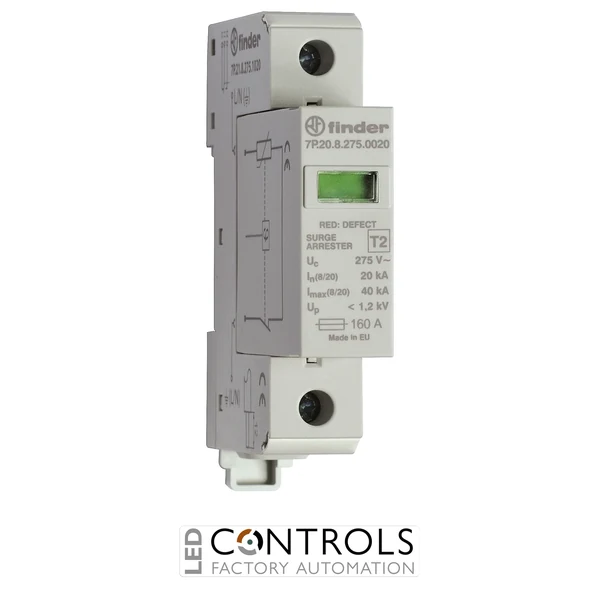
Why Choose the Finder 7P.21.8.275.0020 Type 2 Surge Protection Device?
The Finder 7P.21.8.275.0020 is a compact single-pole Type 2 surge protection device (SPD) designed to help protect low-voltage electrical installations against transient overvoltages caused by switching operations and lightning-induced disturbances. Part of the Finder 7P Series, it provides surge protection for appropriately rated AC electrical distribution circuits.
With a maximum continuous operating voltage (Uc) of 275 V AC and a nominal discharge current (In) of 20 kA, this model is suited to applications requiring Type 2 surge protection on compatible 230 V AC circuits. Its metal oxide varistor protection technology provides a discharge path for transient surge currents, helping limit voltage stress on connected electrical and electronic equipment.
The 7P.21.8.275.0020 is designed for installation in electrical distribution boards and industrial control enclosures. Its modular DIN rail construction, local protection status indication and replaceable protective element support straightforward installation, inspection and maintenance. This variant is intended for applications where remote status signalling is not required.
Key Advantages
- Type 2 surge protection: Helps protect electrical equipment against switching transients and induced lightning surges.
- 275 V AC maximum continuous operating voltage: Suitable for appropriately designed 230 V AC protection applications.
- 20 kA nominal discharge current: Provides defined surge-handling performance using the 8/20 µs test waveform.
- Single-pole construction: Supports integration into suitable single-phase and multipole protection arrangements.
- Metal oxide varistor technology: Responds to transient overvoltages by providing a surge current discharge path.
- Replaceable protective element: Supports maintenance of the surge protection assembly.
- Local status indication: Enables visual inspection of the protective element's condition.
- Compact modular design: Conserves space in electrical distribution boards and control cabinets.
- DIN rail installation: Integrates into standard modular electrical enclosures.
- Suitable for coordinated surge protection: Can form part of a wider electrical installation protection strategy.
- Professional electrical protection: Supports improved resilience of sensitive equipment and control systems.
Key Features
- Finder 7P Series surge protection device.
- 7P.21 single-pole product family.
- Type 2 surge protection classification.
- Metal oxide varistor (MOV) protection technology.
- Maximum continuous operating voltage (Uc): 275 V AC.
- Nominal discharge current (In): 20 kA, 8/20 µs.
- Designed for appropriately rated low-voltage AC electrical systems.
- Single-pole protection arrangement.
- Local visual protection status indication.
- Replaceable surge protection cartridge.
- DIN rail-mounted construction.
- Version without an integrated remote signalling contact.
- Designed for installation within a suitably protected electrical enclosure.
- Type 2 protection characteristics associated with IEC/EN 61643-11.
Technical Specifications
- Manufacturer: Finder
- Series: 7P Series
- Product family: 7P.21
- Model: 7P.21.8.275.0020
- Manufacturer part number: 7P.21.8.275.0020
- Product type: Surge protection device
- SPD classification: Type 2
- Number of poles: 1
- Protection technology: Metal oxide varistor
- Maximum continuous operating voltage (Uc): 275 V AC
- Nominal discharge current (In, 8/20 µs): 20 kA
- Remote signalling: No
- Local status indication: Visual protective element status indicator
- Protective element: Replaceable cartridge
- Mounting: DIN rail
- Application: Low-voltage AC electrical distribution surge protection
- Relevant standard family: IEC/EN 61643-11
Reliable Type 2 Surge Protection for Electrical Distribution Systems
Electrical distribution systems are regularly exposed to transient disturbances generated by switching operations, inductive loads and lightning activity. Although these overvoltage events are generally brief, their magnitude can be sufficient to damage electronic components, reduce insulation life or interrupt the operation of sensitive control equipment. The Finder 7P.21.8.275.0020 helps address these risks through its Type 2 metal oxide varistor protection element.
During normal operation, the surge protector presents a high-impedance path. When a sufficiently large transient overvoltage occurs, the varistor becomes conductive and diverts surge current through the designed protection path. This action helps limit the transient voltage experienced by connected equipment. The device's 275 V AC Uc rating must be matched to the electrical system, while its 20 kA nominal discharge current provides a defined measure of its ability to withstand repeated standardised surge impulses.
The compact construction allows installation in distribution boards, machine control panels and other electrical enclosures. A local status indicator helps maintenance personnel identify the condition of the protective element, while the replaceable cartridge design supports servicing when necessary. The absence of remote signalling makes this model particularly appropriate for installations where local inspection is sufficient.
Effective surge protection also depends on the complete electrical installation. Correct upstream protection, earthing arrangements, conductor routing and coordination with other SPDs are essential. The maximum discharge current, voltage protection level and short-circuit withstand characteristics should be checked against Finder's model-specific documentation before final equipment selection.
Typical Applications
- 230 V AC electrical distribution circuits with suitable system configuration.
- Industrial control panels and automation cabinets.
- Commercial building electrical distribution boards.
- Industrial machinery power supply protection.
- Motor control and process automation installations.
- Power supplies serving PLCs and electronic controllers.
- Building services electrical infrastructure.
- Single-pole Type 2 surge protection arrangements.
- Coordinated surge protection systems.
- Electrical installations requiring locally monitored surge protection.
- Maintenance and upgrading of low-voltage electrical protection systems.