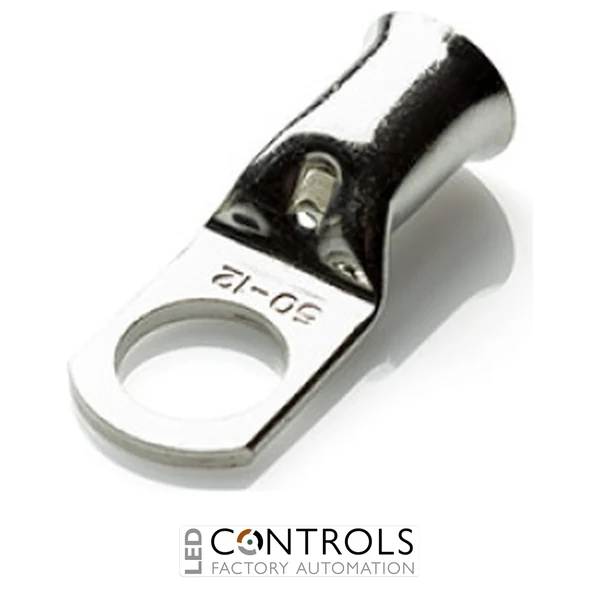
Why Choose the Partex COL50-12 Copper Tube Ring Terminal?
The Partex COL50-12 is a professional 50 mm² copper tube ring terminal designed for terminating electrical conductors onto equipment fitted with an M12 stud or bolt connection. Featuring a tubular copper conductor barrel and closed ring fixing, this terminal provides a practical solution for creating mechanically secured electrical connections in power distribution assemblies, industrial control panels, electrical machinery and other professional electrical installations.
Designed for use with appropriately sized 50 mm² electrical conductors, the Partex COL50-12 combines a crimp-style cable connection with an M12 ring fixing. The closed ring design allows the terminal to be retained beneath suitable fastening hardware, helping provide a secure connection arrangement when correctly crimped and installed. Its copper construction makes it suitable for electrical applications requiring a conductive cable termination component selected to match the conductor and equipment connection.
The 50 mm² conductor capacity makes this terminal particularly relevant to electrical installations involving larger cable cross-sections, where correct conductor preparation, crimping and mechanical support are essential. The M12 ring connection provides a fastening arrangement for compatible equipment terminal studs, subject to verification of the complete connection's electrical and mechanical suitability.
Supplied in a convenient pack of 50 terminals, the Partex COL50-12 is suitable for electrical contractors, control panel manufacturers, OEM machinery builders and industrial maintenance departments carrying out repeated cable termination work. The pack quantity supports efficient component stocking and consistent installation practices across electrical assembly, equipment manufacturing and maintenance projects.
Key Advantages
- 50 mm² conductor compatibility for appropriately sized electrical cable terminations.
- M12 ring connection designed for compatible stud and bolt fastening points.
- Copper tube construction provides a conductive termination component for electrical installations.
- Closed ring design supports secure mechanical retention when correctly installed.
- Suitable for professional electrical panel wiring and equipment assembly.
- Useful for power distribution, industrial machinery and electrical control applications.
- Supports consistent cable termination practices across multiple electrical assemblies.
- Practical for connections to suitable equipment terminal studs and bolted connection points.
- Designed for use with appropriate crimping equipment and compatible tooling.
- Suitable for electrical installation, maintenance, repair and refurbishment work.
- Convenient packaging supports repeated cable assembly and termination operations.
- Pack of 50 provides a practical quantity for panel builders, contractors and maintenance teams.
Key Features
- Partex COL series copper tube ring terminal.
- Manufacturer part number: COL50-12.
- Nominal conductor cross-section: 50 mm².
- Compatible stud size: M12.
- Terminal material: Copper.
- Tube-style conductor barrel for crimp termination.
- Ring-shaped fixing end for compatible stud or bolt connections.
- Designed for cable-end termination using suitable crimping methods.
- Suitable for compatible electrical equipment connection points.
- Practical for industrial control panels, distribution equipment and machinery wiring.
- Supplied as individual terminals for electrical installation and cable assembly work.
- 50 copper tube ring terminals per pack.
Copper Tube Ring Terminals for Power Distribution and Industrial Electrical Connections
Copper tube ring terminals are widely used in electrical installations where conductors must be connected to equipment through mechanically fastened electrical connections. The Partex COL50-12 combines a 50 mm² conductor termination with an M12 ring fixing, making it a practical component for compatible power distribution assemblies, industrial machinery and electrical control equipment.
In electrical distribution and machinery applications, conductors may need to be connected to terminal studs, equipment connection posts or other bolted connection points. The ring-shaped fixing end provides a closed aperture through which the fastening stud or bolt passes. Unlike an open-ended fork terminal, a ring terminal cannot be lifted away from an intact fastening point without first removing the retaining hardware. This makes ring terminals useful where a securely retained cable connection is required.
When working with 50 mm² conductors, correct cable preparation, crimping and mechanical support are particularly important. Larger conductors may require additional consideration of cable bending radius, routing space and strain relief. The cable should not place excessive mechanical load on the terminal barrel or equipment fastening point.
The completed ring connection should be positioned on a compatible M12 stud or bolt and secured using the equipment manufacturer's specified fastening hardware and tightening torque. The conductor cross-section and stud size alone do not establish the permissible current rating or suitability of the complete electrical connection. The equipment terminal rating, conductor construction, contact arrangement, electrical loading and installation conditions must all be verified.
Crimping and Installation Considerations
Correct crimping is essential to the electrical and mechanical performance of a copper tube ring terminal. The conductor should be prepared to the stripping length specified by the manufacturer and inserted correctly into the terminal barrel. Crimping must be carried out using suitable tooling and dies selected for the terminal and conductor construction.
After crimping, the completed termination should be inspected for correct conductor insertion, crimp positioning, mechanical security and visible damage. Where required by the installation, suitable insulation or protective sleeving should be fitted to protect exposed conductive surfaces.
When securing the terminal to an M12 fastening point, the ring should sit correctly against the intended electrical contact surface. The fastening hardware, contact arrangement and tightening torque should follow the equipment manufacturer's instructions. A secure mechanical fixing does not, by itself, confirm that the connection is electrically suitable for the intended load.
Appropriate cable routing and support should also be considered. Excessive bending, pulling or twisting at the crimped connection should be avoided, and the completed installation should be assessed for electrical clearances, vibration, mechanical loading and operating conditions.
Typical Applications
- Industrial electrical control panel wiring.
- Power distribution boards and electrical distribution assemblies.
- Motor control centres and associated electrical equipment.
- Industrial machinery electrical installations.
- Electrical equipment fitted with compatible M12 terminal studs.
- Power supply and electrical conversion equipment connections.
- OEM machinery and electrical equipment manufacturing.
- Building services electrical distribution and control equipment.
- Industrial automation and machinery wiring.
- Electrical equipment maintenance and refurbishment projects.
- Workshop cable assembly and electrical harness manufacturing.
- General electrical cable termination onto compatible bolted connections.