Why Choose the WAGO 750-616 Separation Module?
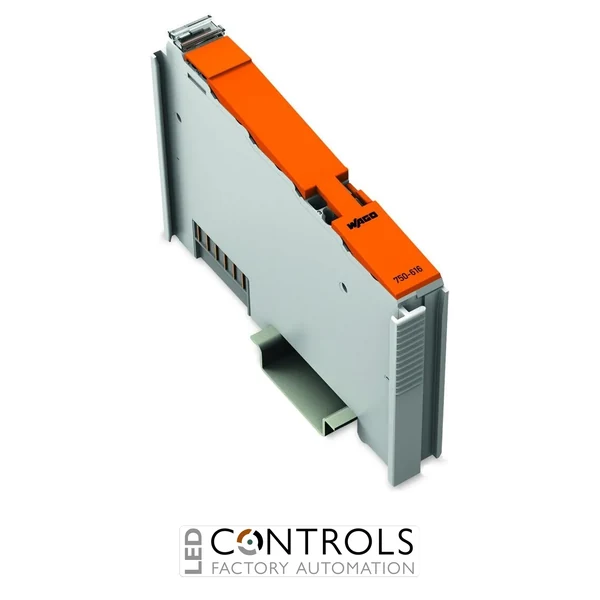
The WAGO 750-616 is a compact separation module designed for the WAGO I/O System 750 and 753. It is used to visually and electrically divide a fieldbus node into sections, helping engineers organise modular I/O assemblies and clearly separate groups of automation modules within distributed control systems.
Part of the WAGO automation product range, the module simplifies system layout by creating clear separation points inside an I/O station. This improves diagnostics, maintenance and system organisation when multiple I/O groups are installed in a control cabinet or machine automation system.
Unlike power supply or distribution modules, the 750-616 does not include power jumper contacts. Its primary purpose is structural separation within the automation node. Adjacent modules still require a separate supply module to provide field power to the system. :contentReference
Key Advantages
- Provides clear visual separation between groups of I/O modules.
- Improves system organisation and diagnostics in distributed automation nodes.
- Compact 12 mm DIN rail module suitable for high-density installations.
- Compatible with WAGO I/O System 750 and 753.
- Supports modular expansion of PLC and fieldbus I/O systems.
- Lightweight design with no additional wiring required.
Key Features
- Separation module for WAGO I/O System 750 / 753.
- Used to divide fieldbus nodes into sections.
- No power jumper contacts.
- Communication and system supply via internal data contacts.
- Compact DIN-35 rail mounting.
- Maintenance-free design with no field wiring connections.
Industrial Automation System Organisation
Large distributed automation systems often contain many I/O modules connected to a fieldbus controller. Separation modules help engineers organise these nodes by dividing the station into logical sections. This makes troubleshooting easier and ensures that groups of I/O modules can be clearly identified during commissioning and maintenance.
The WAGO 750-616 creates this separation without interrupting the internal system bus communication between modules. It therefore improves system structure while maintaining reliable data exchange between the fieldbus controller and connected I/O devices. :contentReference
Typical Applications
- Distributed PLC and fieldbus I/O systems.
- Industrial control cabinets and automation panels.
- Machine automation and production equipment.
- Large modular I/O stations requiring logical segmentation.
- Automation systems requiring clear separation of I/O groups.