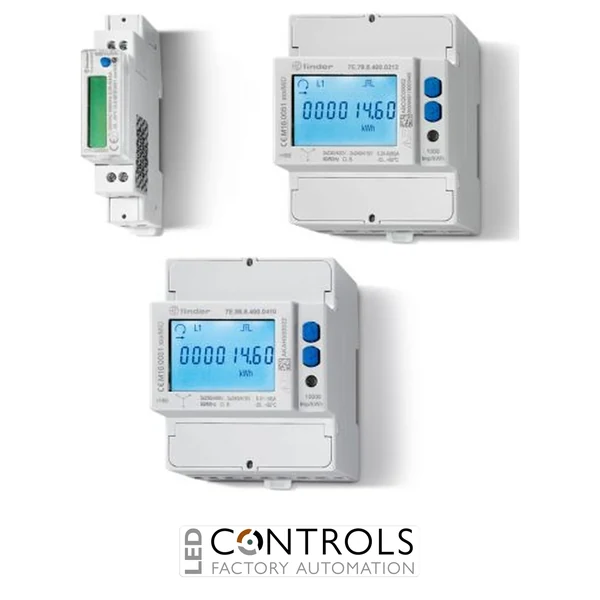
Why Choose the Finder 7E.85.8.400.0210 Three-Phase Energy Meter?
The Finder 7E.85.8.400.0210 is an advanced three-phase multifunction bidirectional energy meter designed for accurate electrical energy monitoring, power measurement and consumption analysis in industrial, commercial and building automation applications. As part of the Finder 7E Series energy meter range, it combines current transformer (CT) measurement, digital communications and comprehensive electrical parameter monitoring in a compact DIN rail-mounted device.
This multifunction energy meter measures both imported and exported active and reactive energy, making it suitable for monitoring electrical consumption and energy generation. Its integrated RS485 Modbus RTU communication interface enables connection to compatible building management systems, industrial controllers and energy monitoring platforms. A backlit LCD display provides local access to electrical measurements and operating information.
Designed for three-phase 230/400 V AC electrical systems, the Finder 7E.85.8.400.0210 operates with external current transformers featuring 1 A or 5 A secondary outputs. Its 6 A maximum current input, multifunction measurement capabilities and bidirectional energy monitoring make it ideal for industrial distribution boards, commercial electrical installations and automated energy management systems.
Key Advantages
- Advanced three-phase multifunction energy meter for industrial and commercial electrical monitoring.
- Bidirectional active and reactive energy measurement supports monitoring of imported and exported electricity.
- RS485 Modbus RTU communication enables integration with industrial automation and energy management systems.
- External current transformer compatibility allows monitoring of electrical installations with different current ratings.
- 1 A and 5 A CT secondary compatibility provides flexible installation options.
- Comprehensive measurement of voltage, current, frequency, power and power factor.
- Active, reactive and apparent power monitoring provides detailed electrical performance information.
- Total harmonic distortion (THD) measurement helps identify power quality issues.
- Maximum demand monitoring supports electrical load analysis and energy management.
- Clear white-backlit LCD display enables convenient local monitoring.
- Configurable Modbus communication settings simplify integration with compatible monitoring equipment.
- Compact 35 mm DIN rail mounting supports installation inside electrical distribution and control panels.
Key Features
- Finder 7E Series multifunction bidirectional energy meter.
- Three-phase 230/400 V AC nominal measurement voltage.
- 1 A or 5 A external current transformer secondary input.
- 6 A maximum current input.
- 0.05–6 A measurement current range.
- 50/60 Hz nominal operating frequency.
- 45–65 Hz frequency measurement range.
- RS485 Modbus RTU interface for remote communication.
- Configurable Modbus communication address and baud rate.
- Two pulse outputs for energy monitoring integration.
- Bidirectional active energy measurement in kWh.
- Bidirectional reactive energy measurement in kVArh.
- Individual phase and total active power measurement.
- Individual phase and total reactive power measurement.
- Individual phase and total apparent power measurement.
- Phase-to-neutral and phase-to-phase voltage monitoring.
- Individual phase current measurement.
- Power factor and frequency monitoring.
- Current and voltage total harmonic distortion monitoring.
- Maximum demand measurement with configurable demand intervals.
- White-backlit LCD display with adjustable backlight duration.
- Support for compatible single-phase and three-phase wiring configurations.
- −40 to +70 °C operating temperature range.
- IP51 front-panel protection for indoor installations.
- Standard DIN rail mounting for electrical distribution boards.
Technical Specifications
- Manufacturer: Finder
- Series: 7E Series Energy Meters
- Model: 7E.85.8.400.0210
- Product type: Multifunction bidirectional electrical energy meter
- Measurement system: Single-phase and three-phase AC electrical systems
- Nominal measurement voltage: 3 × 230/400 V AC
- Phase-to-neutral operating voltage: 100–277 V AC
- Phase-to-phase operating voltage: 100–480 V AC
- Reference current: 1 A
- Current transformer secondary compatibility: 1 A / 5 A
- Maximum current input: 6 A
- Minimum measured current: 0.05 A
- Current measurement range: 0.05–6 A
- Maximum peak current: 120 A for 0.5 s
- Nominal frequency: 50/60 Hz
- Operating frequency range: 45–65 Hz
- Communication interface: RS485 Modbus RTU
- Communication baud rates: 2400, 4800, 9600, 19200 and 38400 bps
- Modbus address range: 1–247
- Communication parity: None, odd or even
- Communication stop bits: 1 or 2
- Pulse outputs: 2
- Tariff configuration: Single tariff
- Energy measurement: Imported and exported active and reactive energy
- Active energy unit: kWh
- Reactive energy unit: kVArh
- Active energy accuracy: Class 0.5S according to IEC 62053-22
- Reactive energy accuracy: Class 2 according to IEC 62053-23
- Voltage measurement accuracy: 0.5% of range maximum
- Current measurement accuracy: 0.5% of nominal value
- Active power measurement accuracy: ±1% of range maximum
- Reactive power measurement accuracy: ±1% of range maximum
- Apparent power measurement accuracy: ±1% of range maximum
- Measured electrical parameters: Voltage, current, frequency, power factor, active power, reactive power, apparent power, energy and harmonic distortion
- Demand monitoring: Maximum current and power demand
- Display: White-backlit LCD
- Operating temperature: −40 to +70 °C
- Storage temperature: −40 to +80 °C
- Front-panel protection rating: IP51 (indoor use)
- Electrical protection class: Class II
- Installation category: CAT III
- Maximum installation altitude: 2000 m
- Mounting type: 35 mm DIN rail
- Applicable measurement standards: IEC 62053-21, IEC 62053-22 and IEC 62053-23
Reliable Energy Monitoring for Industrial Automation and Electrical Distribution
Multifunction energy meters such as the Finder 7E.85.8.400.0210 measure electrical consumption and power characteristics to help operators understand how energy is used across industrial machinery, production facilities and commercial electrical installations. By monitoring voltage, current, active power, reactive power, apparent power and power factor, the meter provides information that can support energy efficiency improvements, electrical load management and preventative maintenance.
The Finder 7E.85 Series uses external current transformers to measure electrical current without routing the full load current directly through the meter. This arrangement makes the device suitable for monitoring higher-current electrical installations when correctly matched with appropriate CTs. Configurable current transformer settings allow the meter to calculate electrical measurements based on the installed transformer ratio.
The integrated RS485 Modbus RTU communication interface enables electrical measurement data to be transmitted to compatible PLCs, building management systems, supervisory control platforms and energy monitoring software. This supports centralised energy data collection, remote monitoring and analysis of electrical performance across multiple installations.
Its bidirectional energy measurement capability is particularly useful in installations where electricity may flow in both directions, including facilities with on-site generation. The meter records imported and exported energy separately, while harmonic distortion and maximum demand measurements provide additional information for power quality assessment and electrical system optimisation.
Typical Applications
- Industrial three-phase electrical energy monitoring.
- Commercial building energy management systems.
- Electrical distribution boards and sub-distribution panels.
- Factory automation and manufacturing facilities.
- Industrial machinery energy consumption monitoring.
- Building management systems with Modbus RS485 integration.
- Energy monitoring of installations with on-site electricity generation.
- Electrical load analysis and maximum demand monitoring.
- Power factor and harmonic distortion monitoring.
- Industrial process control and supervisory monitoring systems.
- Energy efficiency assessment and consumption reporting.
- Electrical submetering in commercial and industrial buildings.
- Remote electrical measurement through industrial communication networks.
- OEM control panels and automated electrical monitoring installations.