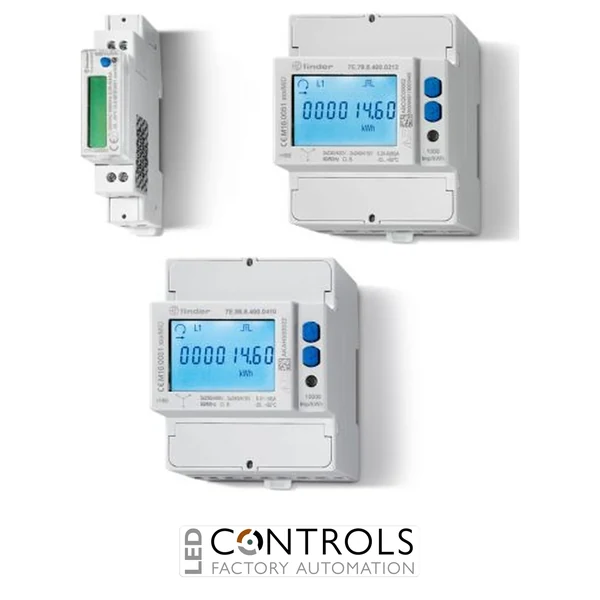
Why Choose the Finder 7E.85.8.400.0212 Three-Phase Energy Meter?
The Finder 7E.85.8.400.0212 is a high-accuracy three-phase multifunction bi-directional energy meter designed for professional electricity monitoring, industrial energy management and building automation applications. Part of the Finder Series 7E, this advanced digital electricity meter combines current transformer (CT) measurement, Modbus RS485 communication, dual-tariff functionality and a clear backlit LCD display in a compact DIN rail mounted housing.
Designed for three-phase electrical systems with or without a neutral conductor, the Finder 7E.85.8.400.0212 provides detailed monitoring of electricity consumption, energy export and electrical network performance. Its nominal 3 × 230/400 V AC measurement capability and 1 A reference current, 6 A maximum current make it suitable for indirect measurement through appropriately selected current transformers.
With support for current transformer ratios corresponding to primary currents of up to 10,000 A, the meter is particularly useful for monitoring larger industrial and commercial electrical installations. Its MID-certified accuracy class C (0.5S) provides dependable energy measurement for applications requiring a high level of measurement accuracy.
The integrated RS485 Modbus RTU interface enables measured values to be transmitted to compatible building management systems, industrial controllers and energy monitoring platforms. Two S0 pulse outputs, dual-tariff functionality and bi-directional energy measurement further support flexible integration into modern electrical monitoring systems.
Key Advantages
- Three-phase multifunction energy meter for industrial and commercial electrical monitoring.
- Bi-directional energy measurement for monitoring imported and exported electrical energy.
- MID-certified accuracy class C (0.5S) for high-accuracy active energy measurement.
- Integrated RS485 Modbus RTU communication for remote monitoring and data acquisition.
- Dual-tariff functionality for monitoring energy usage across two tariff periods.
- Current transformer operated for indirect measurement of higher-current electrical circuits.
- Compatible with CT ratios up to 10,000 A primary current, subject to correct configuration.
- 1 A reference current and 6 A maximum current at the meter's measurement inputs.
- 3 × 230/400 V AC nominal measurement voltage for compatible three-phase networks.
- Three-phase three-wire and four-wire compatibility for flexible installation.
- Two S0 pulse outputs for integration with compatible pulse-counting equipment.
- Backlit LCD display for convenient local monitoring.
- Measurement of active and reactive energy for detailed electrical analysis.
- Monitoring of voltage, current, frequency, power and power factor.
- 35 mm DIN rail mounting for straightforward control cabinet installation.
- Four-module housing width for compact electrical distribution boards.
- Suitable for energy management, renewable generation monitoring, industrial metering and building management systems.
Key Features
- Finder Series 7E multifunction electricity meter.
- Product type: Three-phase bi-directional energy meter.
- Measurement method: Indirect measurement using external current transformers.
- Nominal voltage: 3 × 230/400 V AC.
- Nominal frequency: 50/60 Hz.
- Operating frequency range: 45–65 Hz.
- Reference current: 1 A.
- Maximum measurement input current: 6 A.
- Minimum measured current: 0.05 A.
- Active energy accuracy: Class C / 0.5S.
- Reactive energy accuracy: Class 2.
- MID certification for applicable metering applications.
- Communication: RS485 Modbus RTU.
- Pulse outputs: 2 × S0.
- Tariff configuration: Dual tariff.
- Energy flow measurement: Import and export.
- Display: White-backlit LCD.
- Installation: Three-phase three-wire or four-wire systems.
- Mounting: 35 mm DIN rail.
- Housing width: 4 modular spaces.
- Protection rating: IP51.
Technical Specifications
- Manufacturer: Finder
- Series: 7E
- Product type: Multifunction bi-directional electricity meter
- Manufacturer part number: 7E.85.8.400.0212
- Meter type: Three-phase electronic energy meter
- Measurement method: Current transformer operated
- Supported electrical networks: Three-phase, three-wire and four-wire
- Nominal system voltage: 3 × 230/400 V AC
- Line-to-neutral operating voltage: Approximately 100–277 V AC
- Line-to-line operating voltage: Up to 480 V AC
- Nominal frequency: 50/60 Hz
- Operating frequency range: 45–65 Hz
- Reference current: 1 A
- Maximum current: 6 A
- Minimum measured current: 0.05 A
- Short-duration overcurrent withstand: 120 A for 0.5 s
- Maximum supported CT primary current: 10,000 A with suitable current transformers
- Active energy accuracy: Class C / 0.5S
- Reactive energy accuracy: Class 2
- Applicable active energy standards: IEC 62053-22 and EN 50470-3
- Reactive energy standard: IEC 62053-23
- Certification: MID
- Energy measurement direction: Bi-directional, import and export
- Energy quantities: Active and reactive energy
- Additional measurements: Voltage, current, frequency, active power, reactive power, apparent power and power factor
- Communication interface: RS485
- Communication protocol: Modbus RTU
- Configurable Modbus baud rates: 2400, 4800, 9600, 19200 and 38400 bps
- Modbus address range: 1–247
- Pulse outputs: 2 × S0
- Tariff function: Dual tariff
- Display type: White-backlit LCD
- Mounting type: 35 mm DIN rail (EN 60715)
- Housing width: 4 modular spaces, approximately 72 mm
- Protection rating: IP51
- Operating ambient temperature: −40 to +70 °C, subject to the manufacturer's installation requirements
- EAN / GTIN: 8012823461342
Advanced Bi-Directional Three-Phase Energy Measurement
The Finder 7E.85.8.400.0212 is designed to measure electrical energy flowing in both directions through a compatible three-phase installation. This enables monitoring of energy imported from an electricity supply as well as energy exported by equipment such as photovoltaic generation systems or other distributed energy sources.
Bi-directional measurement is particularly valuable in installations where electricity is both consumed and generated. By distinguishing imported and exported energy, the meter can provide information to support energy performance analysis, load management and the monitoring of on-site electricity generation.
In addition to accumulated active energy in kWh, the meter supports reactive energy measurement in kvarh and a range of instantaneous electrical parameters. These measurements help engineers understand how electrical loads behave and identify opportunities for improved energy management.
The meter's Class C / 0.5S active energy accuracy and MID certification make it suitable for applications requiring precise energy measurement, subject to the relevant regulatory requirements and correct installation.
For three-phase systems, monitoring each phase can help reveal electrical load imbalances and unusual operating conditions. The measured data can be used by compatible supervisory systems to support preventive maintenance, energy reporting and operational decision-making.
Current Transformer Measurement for High-Current Installations
Unlike a direct-connected electricity meter, the Finder 7E.85.8.400.0212 uses external current transformers to measure the current flowing through the monitored electrical circuits. The current transformers convert higher primary currents into lower secondary currents suitable for the meter's measurement inputs.
This arrangement enables the meter to be used in electrical installations with substantially higher current levels than its 6 A maximum measurement input current. With appropriately selected CTs and the correct configuration, the Finder 7E.85 supports measurement of primary currents up to 10,000 A.
The meter's 1 A reference current and maximum 6 A input rating describe the current at its measurement terminals, not the maximum current flowing through the installation being monitored.
Correct CT selection is essential for accurate measurement. The CT ratio, secondary rating, polarity, accuracy class and burden must all be appropriate for the installation and compatible with the meter.
For MID-controlled applications, the manufacturer's instructions restrict the configuration of the current transformer ratio. The selected CT settings should therefore be checked carefully before commissioning.
Important: Current transformer secondary circuits must be handled in accordance with applicable electrical safety procedures. A CT secondary must not be left open-circuit while the primary conductor is energised.
Integrated Modbus RS485 Communication for Energy Management
The Finder 7E.85.8.400.0212 incorporates an RS485 communication interface using the Modbus RTU protocol. This enables compatible automation systems to retrieve electrical measurements and energy consumption information from the meter.
Modbus RTU is widely used in industrial automation and building management systems, making the meter suitable for integration with compatible PLCs, supervisory control systems, energy monitoring gateways and data acquisition equipment.
The communication interface supports configurable baud rates of 2400, 4800, 9600, 19200 and 38400 bps. Its configurable network address range of 1–247 allows multiple compatible devices to operate on an appropriately designed RS485 network.
When connected to a suitable monitoring platform, the meter can support the collection of energy data for analysis, reporting and trend monitoring. This helps facilities managers and engineers track electricity consumption and assess the performance of individual circuits or equipment groups.
In addition to Modbus communication, the meter provides two S0 pulse outputs for integration with compatible pulse-counting devices. These outputs can be used where pulse-based energy monitoring is required.
Dual-Tariff Energy Monitoring
The Finder 7E.85.8.400.0212 includes dual-tariff functionality, allowing energy measurements to be allocated to two tariff registers according to the configured tariff control arrangement.
This capability is useful in installations where electricity consumption is analysed across different operating periods or tariff categories. For example, facilities may wish to distinguish energy consumption associated with different production schedules or electricity pricing periods.
By combining dual-tariff monitoring with bi-directional energy measurement, the meter provides additional flexibility for energy reporting and the assessment of electricity import and export patterns.
Actual tariff billing suitability depends on the applicable metering regulations, tariff control configuration and requirements of the electricity supplier or billing authority.
DIN Rail Installation and Electrical Integration
The Finder 7E.85.8.400.0212 is designed for mounting on a standard 35 mm DIN rail within a suitable electrical distribution board or industrial control cabinet. Its four-module housing width supports installation alongside compatible circuit protection, monitoring and automation equipment.
The meter can be used in suitable three-phase three-wire and three-phase four-wire installations. The correct wiring arrangement must be selected according to the electrical network and the manufacturer's connection diagrams.
For reliable measurement, each current transformer must be connected to the appropriate phase and installed with the correct polarity. Incorrect phase association or CT polarity can result in inaccurate energy measurements or reversed import/export readings.
The Modbus RS485 connection should be installed using suitable communication cabling and termination practices for the network design. Where S0 pulse outputs are used, the connected monitoring equipment must meet the manufacturer's electrical interface requirements.
Electrical installation and commissioning should be carried out by suitably qualified personnel. The meter is a measurement device and does not replace circuit breakers, isolators, residual current protection or other required electrical safety equipment.
Typical Applications
- Three-phase industrial electricity monitoring.
- Commercial building energy management systems.
- Industrial plant and machinery energy measurement.
- Bi-directional electricity import and export monitoring.
- Photovoltaic and distributed generation monitoring.
- Factory and production line energy analysis.
- Electrical distribution board sub-metering.
- Current transformer operated high-current installations.
- Building management system (BMS) integration.
- Modbus RS485 energy monitoring networks.
- Dual-tariff electricity consumption analysis.
- Industrial energy efficiency programmes.
- Power quality and electrical parameter monitoring.
- Energy reporting and operational cost allocation.
- Commercial and industrial facility management.