Pizzato E61DM010K-D111 Potentiometer E6 Series 10kΩ Cermet Rotary Control
Why Choose the Pizzato E61DM010K-D111 Potentiometer?
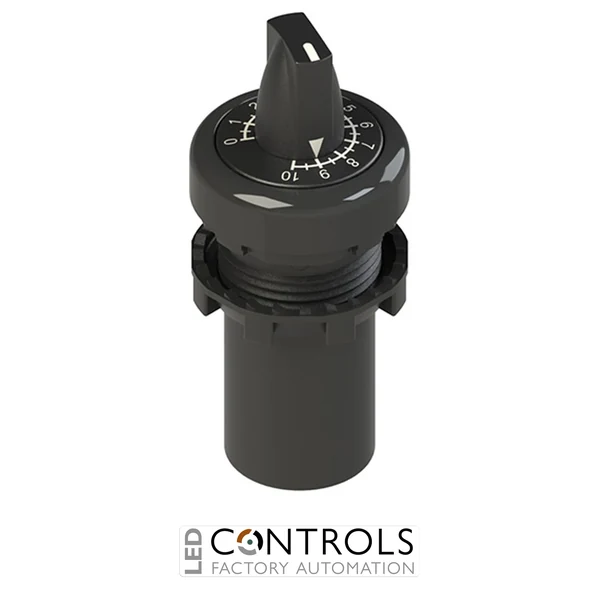
The Pizzato E61DM010K-D111 is a high-quality rotary potentiometer from the E6 DM series,
designed for accurate analogue adjustment in industrial control and automation applications.
Featuring a 10 kΩ resistance value and a durable 1 W cermet resistive element, this
potentiometer provides stable adjustment, excellent reliability and long service life.
Designed for Ø22 mm control panel mounting, the E61DM010K-D111 integrates a compact
monolithic design with PUSH-IN spring terminals for efficient wiring and dependable
electrical connection. The black ring finish provides a clean appearance suitable for
industrial operator interfaces.
Key Advantages
- Precise analogue adjustment for industrial control equipment.
- 10 kΩ resistance value for flexible signal adjustment applications.
- Cermet technology for improved stability and durability.
- 1 W power rating for reliable industrial operation.
- PUSH-IN spring terminals for fast and secure installation.
- IP67 and IP69K protection ratings for demanding environments.
Key Features
- Pizzato E6 DM series industrial potentiometer.
- Model: E61DM010K-D111.
- Resistance: 10 kΩ.
- Resistive element: Cermet.
- Power rating: 1 W.
- Connection type: PUSH-IN spring terminals.
- Black ring finish.
- Integrated rotary adjustment control.
- Designed for Ø22 mm panel mounting.
Reliable Analogue Control for Industrial Automation
The Pizzato E61DM010K-D111 provides operators and engineers with a dependable method of
adjusting analogue parameters in machinery, control panels and automation systems.
Its cermet construction ensures consistent electrical performance while maintaining
excellent mechanical durability.
Combining compact construction, environmental protection and simple push-in wiring,
this E6 series potentiometer is ideal for OEM equipment and industrial applications
requiring accurate manual adjustment and reliable operation.
Typical Applications
- Industrial control panels.
- Machine operator interfaces.
- Automation equipment adjustment.
- Process control systems.
- OEM machinery integration.
- Analogue signal control applications.